Tools & Tutorials
Professional Email Signature Design Using Claude AI (and Claude Design)
A professional email signature without the subscription. The original method, using Claude as a coding partner, plus a 2026 update using Claude Design.
29 Jan 2026 · Updated 14 May 2026 · 5 min read · By Sophie Kazandjian
If you want a professional email signature that works reliably in Outlook and Gmail without paying for another subscription tool, this is a simple way to design one using Claude AI. The original post walks through Claude as a coding partner. The update at the bottom shows how Claude Design, released in 2026, has made the same job even simpler.
Update · May 2026
Claude Design now handles most of the work in a single canvas. Skip ahead to the 2026 update if you want the newer method first, or read the original story for the coding-partner approach.
My email signature had been quietly neglected. It still worked, but it had that familiar feel of something designed years ago and never revisited. The colours no longer matched my brand, some social links were outdated, and overall it no longer reflected the business I run today.
I could have rebuilt it myself. I work with CSS regularly on client websites and I am comfortable writing code. But HTML email signatures are their own special category of frustration. Outlook renders things differently from Gmail, tables still matter, and small visual tweaks often require far more testing than they should. It is the kind of task that absorbs time without adding much value.
So I tried a different approach. I treated AI as a coding partner rather than a design tool. I stayed responsible for decisions around layout, colours, spacing, and content, and used Claude to handle the repetitive coding and the trial and error across email clients. That balance made all the difference.
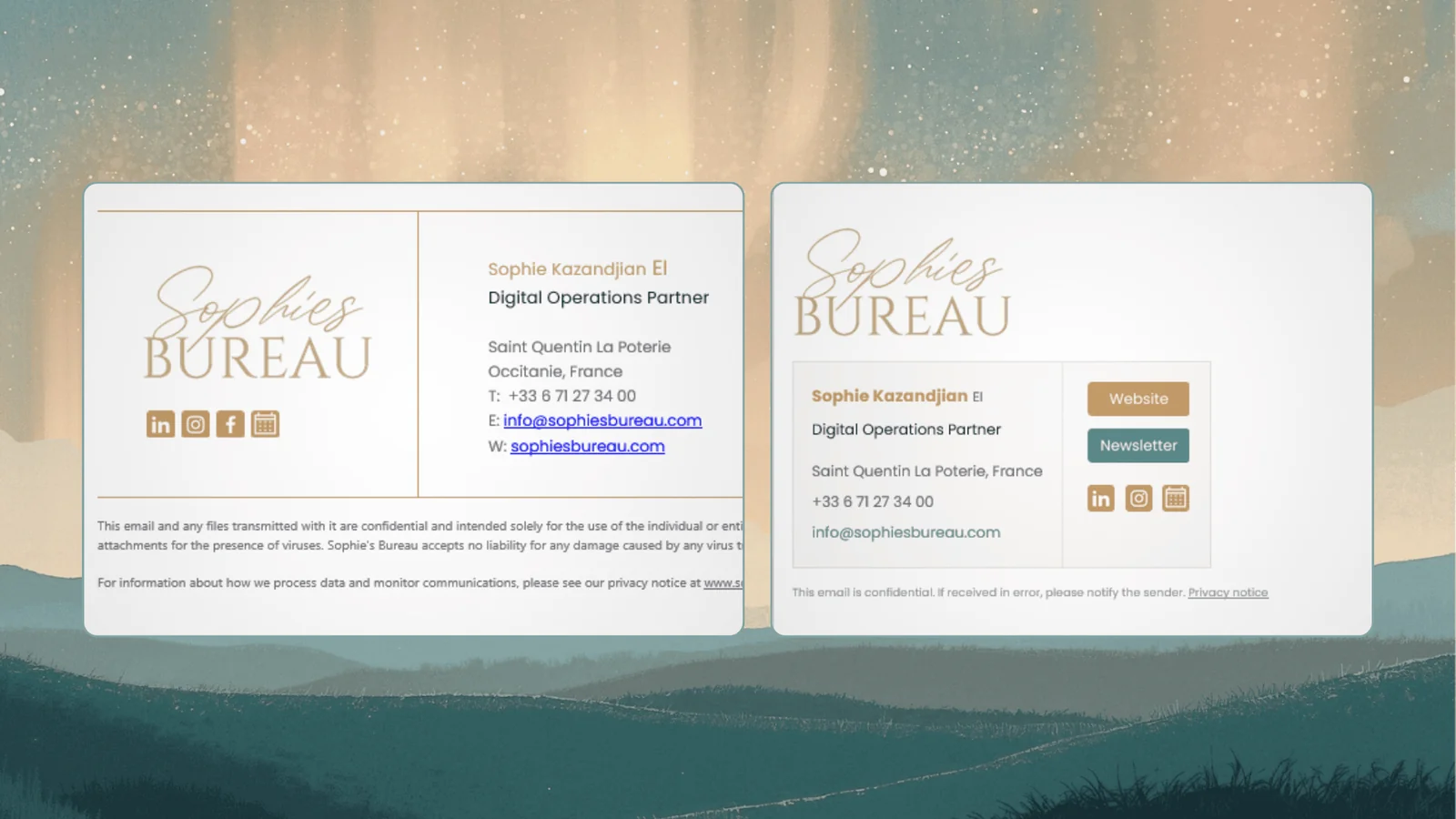
Before and After: From Cluttered to Professional Email Signature
The old signature (on the left) was cluttered, visually inconsistent, and still linked to platforms I no longer use. The disclaimer was long and unwieldy.
The new version (on the right) is clean and restrained, uses my brand colours of dusty gold and teal, and includes properly aligned buttons that render consistently. It finally looks like it belongs to a business in 2026.
Why This Worked
What made this process effective was clarity of roles. I stayed firmly in the design seat, making judgement calls about how the signature should look and function, while Claude handled the implementation details.
When I asked for buttons to be the same width, it tried CSS based solutions first, then moved to table layouts when Outlook failed to cooperate. When borders clipped, it adjusted padding. When consistency mattered more than flexibility, it switched to image based buttons to guarantee reliable rendering across email clients.
I even had Claude generate the button images themselves, sized correctly and styled to match my brand, ready to upload and drop into the signature. That removed another small but fiddly step that usually slows this kind of work down.
These are exactly the tasks that tend to eat time. Testing. Tweaking. Fixing edge cases. By letting AI absorb that layer of work, I reached a polished result far faster than I would have working alone, without giving up control or quality. This is generally how I use AI in digital operations. Human judgement sets direction, AI supports execution, and a final human check signs it off.
How to Create Your Own Professional Email Signature with Claude (Step‑by‑Step)
This approach works whether you are comfortable with code or have never touched HTML before. What matters most is knowing what you want your signature to communicate and being able to describe it clearly.
I have put together a short step by step PDF guide that walks you through the entire process, from preparation to installation.
What to prepare before you start
Example prompts you can adapt
How to iterate without breaking layouts
How to install your signature in Outlook on Windows and Mac
How to install it in Gmail
How to troubleshoot common issues
The guide is free, and there is no subscription involved, unlike many signature tools that charge monthly for something you may only update once every few years.
Download the email signature guide (free PDF)
Update · 14 May 2026
The 2026 update: designing the same signature with Claude Design
Anthropic released Claude Design earlier this year as a research preview. It lives at claude.ai/design and gives you a visual canvas alongside the chat, so instead of pasting HTML into a chat reply and squinting at code, you watch the signature render live as you describe it.
I went back into the same conversation about my signature, this time inside Claude Design, and asked for the same brief. Within one back and forth, it produced three variations on a single preview page, each with a live email mock-up next to its copy-paste HTML.
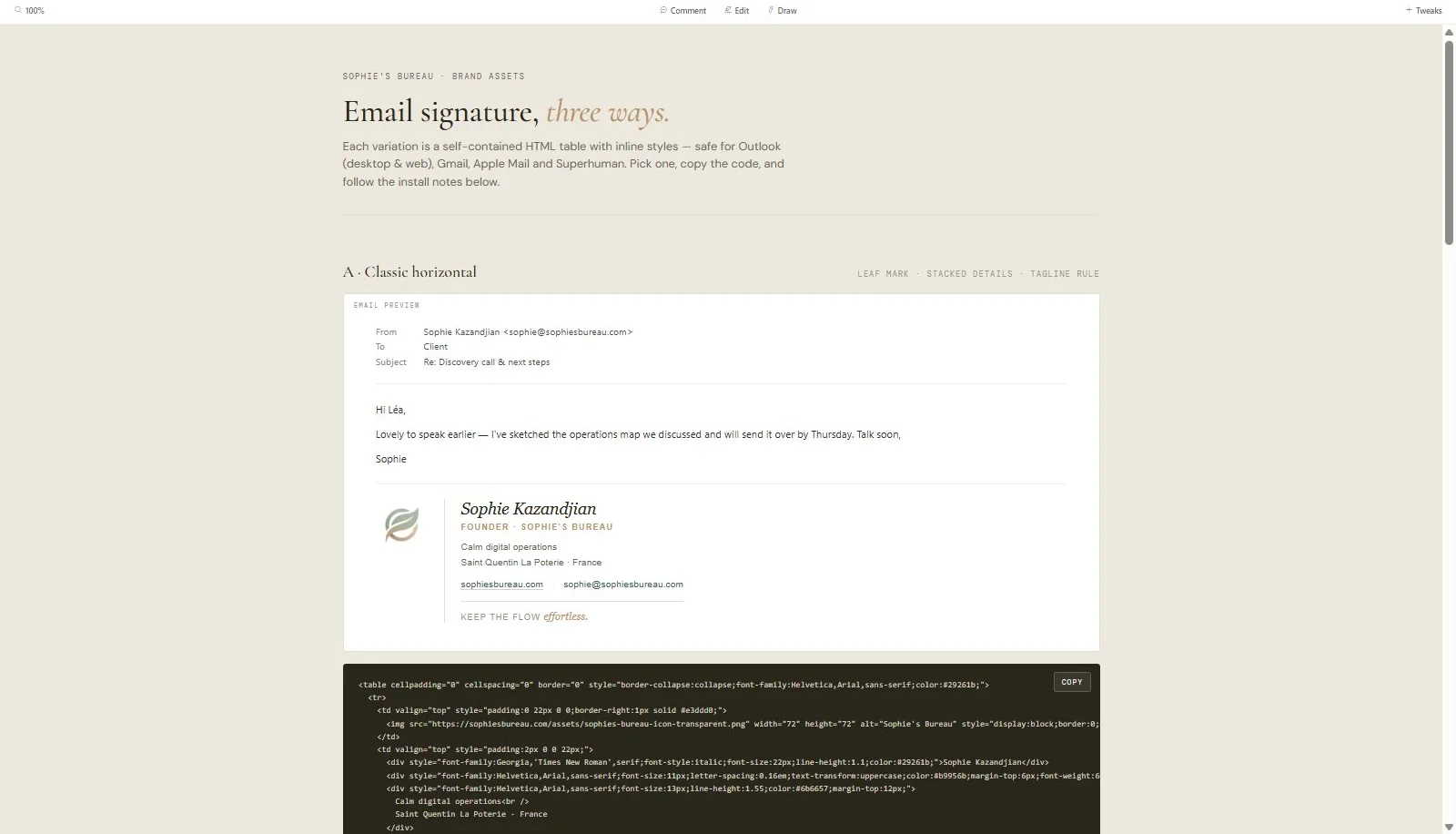
The three options it generated:
Classic horizontal. Leaf mark on the left, italic serif name, tan and teal accents, tagline rule. The most branded of the three.
Text-only minimal. No image, single line of details with thin dividers. Safest for replies and recipients who block remote images.
Editorial card. Teal left rule, italic tagline, and a Book a 45-minute consultation button linking through to my Acuity scheduler.
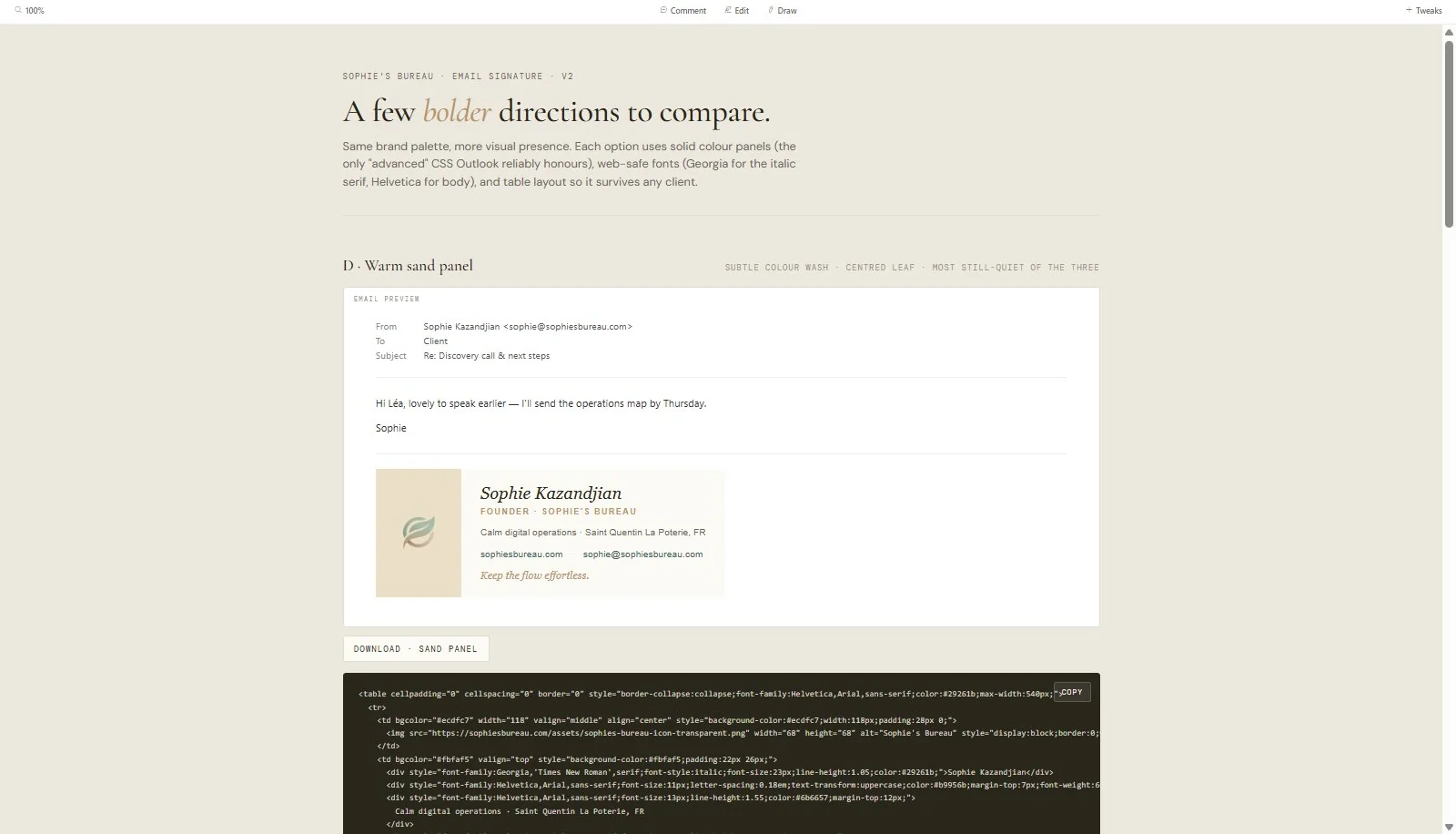
I asked for bolder directions to compare against the quieter set, and it produced three more: a warm sand panel, a charcoal business card, and a sage editorial layout with a tagline framed as a pull-quote.
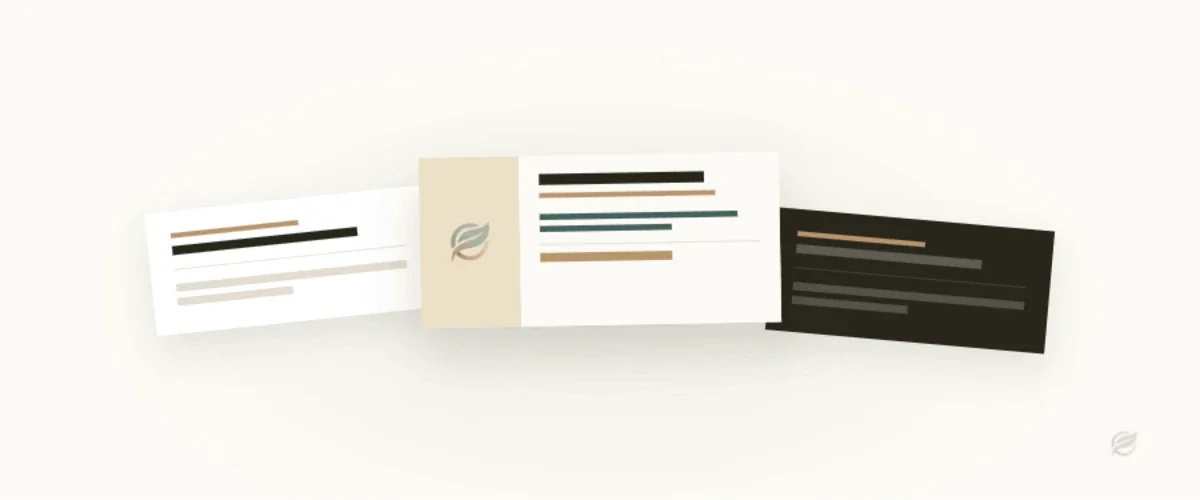
What changed compared to the original method
The split is cleaner than I expected. In the original method, I was directing the design verbally and reading the result inside a code block. In Claude Design, I can see the rendered signature next to the code at every step. When something does not look right, I describe what I want and the preview updates.
Three practical differences stood out:
Live preview while you design. The email preview shows From, To, Subject and a short message above the signature, so you can see how it actually sits at the bottom of a real reply rather than as an isolated block.
Multiple variations side by side. Instead of asking for one signature and iterating, you get a comparison page. Easier to commit to a direction when you can see the alternatives in the same view.
Standalone download files. Each option came with a download button for the HTML file, ready to open locally and copy into Outlook or Gmail.
Is Claude Design available to everyone?
Not quite. Claude Design is currently in research preview and is included on the paid Claude plans: Pro, Max, Team and Enterprise. It is not available on the Free plan. For Enterprise organisations it is off by default and needs to be enabled by an admin.
It has its own weekly usage allowance that sits separately from the regular Claude chat limit, which is worth knowing if you have an ambitious afternoon planned. I hit the cap a few times mid-iteration and had to wait a day to continue. The cap resets, the work in progress is preserved, but if you are working to a deadline plan your design sessions in shorter focused passes rather than one long sprint.
Should you use the original method or Claude Design?
Both still work. If you already have a Pro or Max subscription, Claude Design is the more comfortable starting point for this kind of visual task because you see the result as you describe it. If you are working on the Free plan, or you want to understand how the HTML is put together so you can adjust it yourself later, the original coding-partner method is still completely viable. You can do the whole thing in a regular Claude chat without ever opening the design canvas.
The principle that made the original work has not changed. Human judgement decides what the signature should communicate and how it should feel. AI handles the table layout, the inline styles, the cross-client edge cases, and the production of the final file. A final human check signs it off before it goes anywhere near a real recipient.
If you have questions or want to share what you built, get in touch with me.
If you would like more ideas for using AI in practical, low‑drama ways, you can explore my 2026 AI stack for calm, human‑led digital operations.