Case study
Plenty of Grapes
A hand-coded home for two anthologies, moved off Squarespace and built to be read rather than navigated.
Literary anthology · author site · 2022 → 2026 · Squarespace site, rebuilt with Claude Design on Cloudflare · Claude Design · Cloudflare Pages · hand-coded
Live site: plentyofgrapes.co.uk
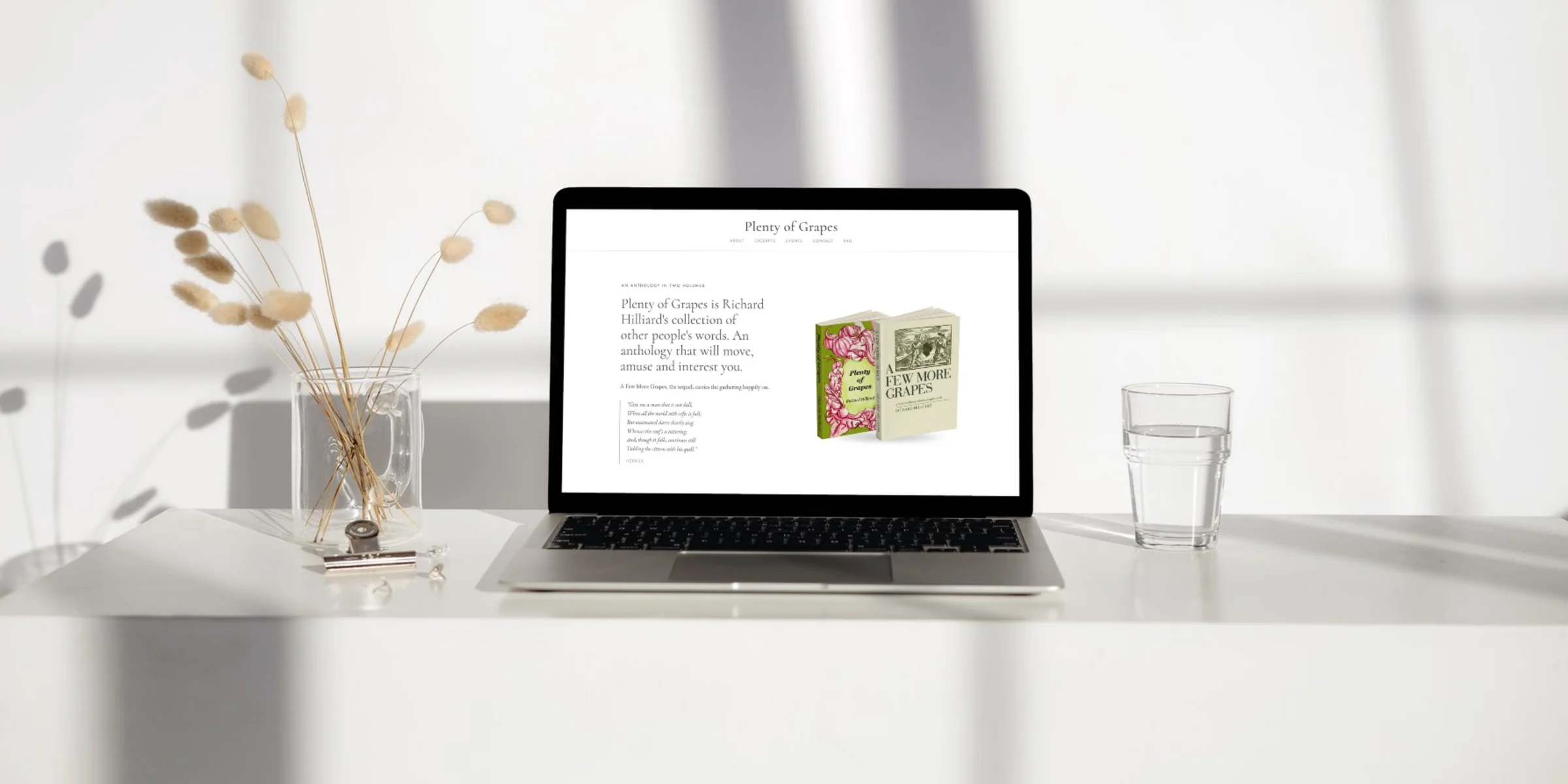
The brief
Richard Hilliard has spent a lifetime gathering other people's words. Plenty of Grapes brought the best of them together in 2018, an anthology that wanders from a Hampshire churchyard to Baudelaire by way of a tenth-century riddle. He recently published a second volume, A Few More Grapes, and asked me to add it to the site.
Richard is the same client whose coaching practice sits a few entries along in this portfolio. This was his other half, the magpie habit of forty years, the pieces he had kept because they moved or amused him. He wanted somewhere to stand the two books together, let people read a few sample pieces, and write to him for a copy. Not a shop. A reading room.
Adding the book was a small job; the opportunity was the larger one. The old site ran on Squarespace, a subscription kept alive to host a handful of pages that change once or twice a year, and a second volume was the moment to leave it behind. We rebuilt it by hand on Cloudflare and the monthly bill stopped.
What I built
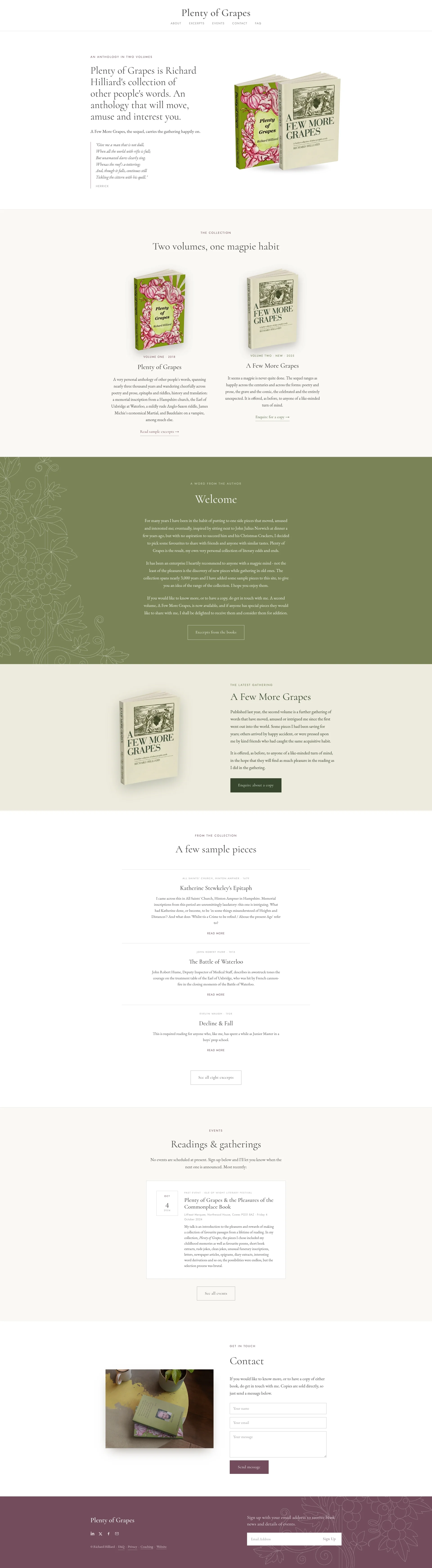
The design takes its colours from the book: sage green and a dusky rose against a lot of white, with Cormorant for the headings and EB Garamond for the reading. It is one page, scrolling through a sequence of quiet views. The two covers stand together in the hero. Below them, a welcome in Richard's own voice on a sage panel, then both volumes set side by side under the line he liked, one magpie habit. The sample excerpts open into reading pages of their own.
Fine grapevine line-work sits in the corners of the coloured panels, drawn as artwork so it stays sharp at any size instead of softening the way a background image would. Sections fade and rise as you reach them, and the header tucks away as you read down, then returns when you scroll up. All of it gives way the moment a reader has reduce-motion turned on.
Underneath, the parts that do the work. The contact and newsletter forms post to Formspark, with a clear message if a send ever fails. There are no cookies, and no banner asking about them. Findability is set up properly: structured data, a social card, a sitemap, and an llms.txt so an assistant describing the books gets them right.
A site that changes once every few years has no business charging rent every month.
Off the subscription
No template shared with a hundred other author sites, and the look belongs to the book. Richard does not log in to rearrange pages himself, which for a site that changes when a new volume arrives is the right shape for it.
It is not sealed shut, though. The excerpts are a small collection with their own pages and previous-next navigation, so a ninth one is a short edit, not a rebuild. A new event slots in the same way, and a checkout could too, if Richard ever decides to sell the books from the site rather than by email. Small changes come back to me and usually go live the same day.
The full homepage
Built in a morning
Before I wrote the brief, I went through Richard's existing site with Claude in Chrome, page by page, so the brief described the site as it actually was and not as either of us half-remembered it. It pulled out all the old images as it went, which spared me downloading them one by one from the Squarespace assets, a painfully slow job on its own. The whole site was written and deployed in a single morning of solid work, with only a few tweaks left once the build was underway.
That speed is the part people misread. Working with Claude I write and refine custom code far faster than I could alone, which is what brings a hand-built site within reach of one author and two books. What the speed does not do is remove the judgement. The first draft of almost anything comes back fast and plausible, and wrong in a corner or two.
Most of the character came from the small things I noticed once the site was live. The space above the title felt tight and needed room to breathe. A soft shadow settled the books onto the page, where they had been floating. On a phone, the grapevines crowded the words and came off on mobile.
What he keeps
A single-page site has one address by default. So the main views took their own clean URLs, the kind you can send someone or post beneath a reading, each one listed for search engines to find.
What he has now reads more like the books than the old site did, and it is his to keep: the code, the fonts, the words. The bill that used to arrive every month simply stopped.