Case Studies
I Rebuilt My Father's Website With Claude, for His Birthday
My father was a Scottish artist. I moved his site off Squarespace, rebuilt it with Claude Design on Cloudflare, and gave every one of his works its own page so his art can finally be found.
16 Jul 2026 · 7 min read · By Sophie Kazandjian
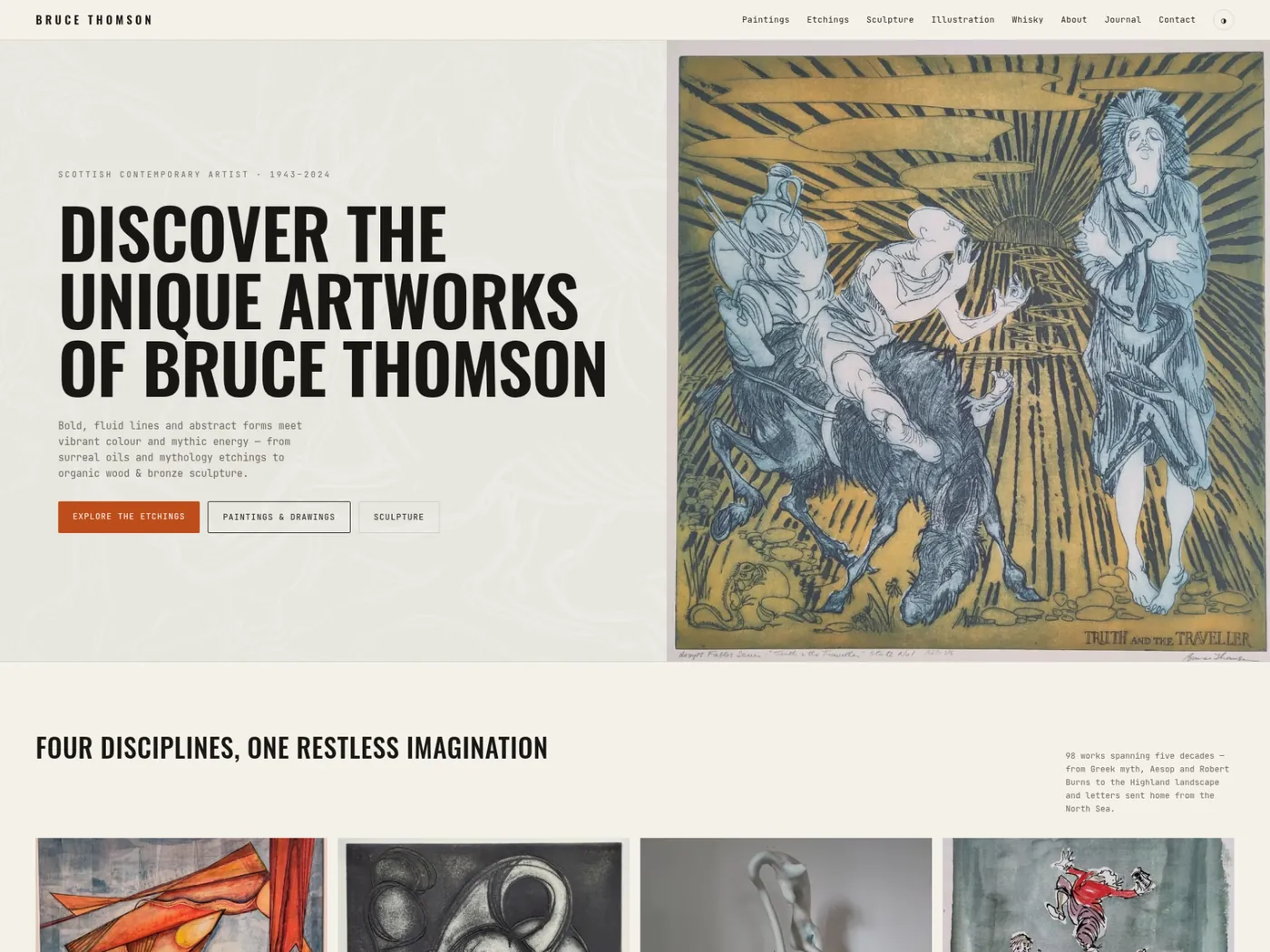
My father, Bruce Thomson, was a Scottish artist. Painting, etching and sculpture across fifty years, drawing on Greek myth and Aesop and Robert Burns, with one memorable detour into the labels for a millennium bottling of Glenfarclas 40 Year Old. He died in 2024. His birthday falls this week, and I wanted to mark it by giving him something useful: a proper upgrade to his website, so the work is shown as it should be and can, at last, be found.
His old site was on Squarespace. It had served him well, but the subscription kept climbing and the design only ever bent so far. So I rebuilt the whole thing with Claude Design and put it on Cloudflare, which hosts it for nothing. It is the same move I made with my own site, and with a growing number of projects in the portfolio. I used a few different Claude modes along the way, and I am writing the process down in case it helps someone else do the same for work they love.
Extracting an old Squarespace site into clean, reusable content
The first job was salvage, not design. Using Claude in Chrome, I went through the old site and had it pull everything into one clean, organised record: all the text, every image with its filename and alt text, and the full structure. That turned a tired site back into source material I could reuse, rather than something to screenshot and retype. It is the step that quietly decides everything after it, because a complete, structured extraction means nothing is lost in the rebuild and nobody loses a week to data entry. In the same pass I had it help me write the design brief, so the goals and tone were on paper before any pixels existed.
Briefing Claude Design before it builds
For the build I moved to Claude Design and gave it the brief, the content, the structure and the images. Before it made anything it asked a few questions: audience, tone, how much variation I wanted. Answering those up front meant the first draft arrived close to right rather than needing to be argued into shape. This is where the flexibility told. On Squarespace I was choosing between templates; here I was describing what I wanted and getting it. If you have ever felt a platform's ceiling pressing down, this is the difference.
A masonry art gallery that keeps each work's true proportions
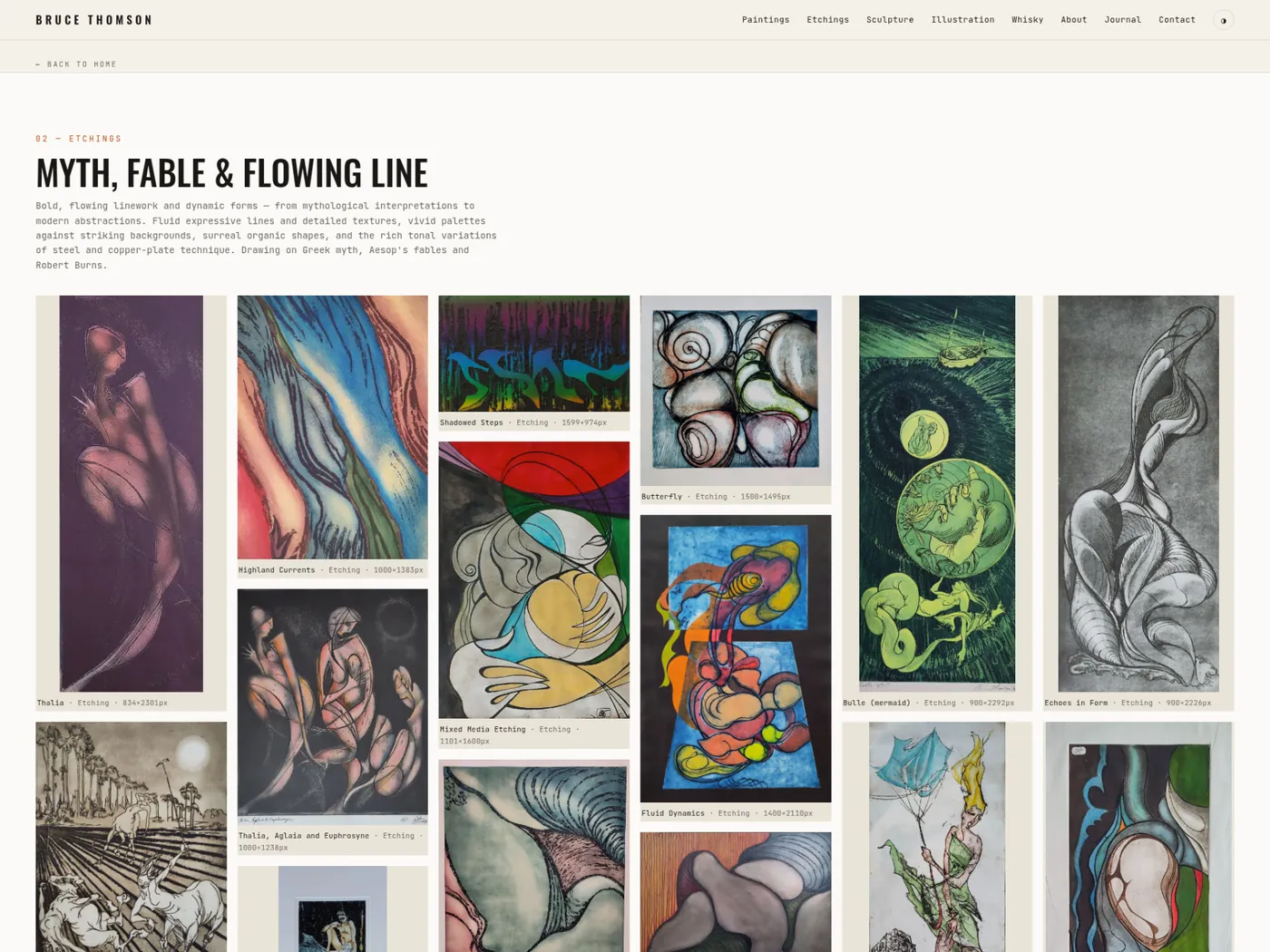
The build was one page with numbered sections, Paintings and Drawings, Etchings, Sculpture, each with a short curatorial introduction and a masonry gallery. The galleries came from a plain list of works, title, filename, dimensions and medium, so they reflow to each image's real proportions. That did more work than it sounds. Dad's pieces run from near-square etchings to portraits almost five times taller than they are wide, and forcing them into uniform squares would have wrecked half of them. Driving the layout from true dimensions let the design bend to the art.
Curating the catalogue: corrections in plain language
Then the part only I could really do, because I know his catalogue: the curation. I reviewed candidate images on a contact sheet and made corrections in ordinary language. Retitle these as etching plates. This one is an ink drawing, not an etching. Tighten this paragraph. Each was actioned as a small, contained change with nothing else disturbed, so I could keep reviewing without a fix quietly breaking something elsewhere. I added privacy-first, cookie-free analytics with a pasted snippet, the same Simple Analytics approach I use across my sites, and pulled a ready-to-host folder whenever I needed one, with the live and working versions kept in step.
Making a JavaScript-rendered art site load fast
The site looked finished here. It was not yet found, and this last stage, in Claude's Cowork mode, is the part I would tell anyone not to skip. Reading the built page showed it rendered entirely in the browser, fetching React, ReactDOM and a full copy of Babel from a public CDN, about three megabytes of JavaScript, and compiling live on every visit. Serving those files from the site itself removed the delay and the dependency. Converting every artwork to WebP dropped the image weight from about 36MB to 21.5MB with no visible loss, the main hero image went from 225KB to 107KB, and deferring the blocking script and unblocking the fonts finished it.
Giving every artwork its own page for SEO
The harder problem was being found at all, which affects any site drawn entirely by JavaScript. The raw HTML a search engine sees first held almost none of the gallery, and the sections lived behind hash URLs that Google treats as one page, so for all the good metadata there was effectively a single page to index. We built the missing layer by hand from the same catalogue the gallery used: a real static page for every one of Dad's works, grouped by discipline at addresses like /etchings/leda-and-the-swan, each with its own title, description, social preview and structured data. Section pages, a feature page for the Glenfarclas commission, a rewritten sitemap and catalogue links in the home page's raw HTML went in alongside. The gallery itself stayed exactly as built. One page Google could see became more than a hundred ways in.
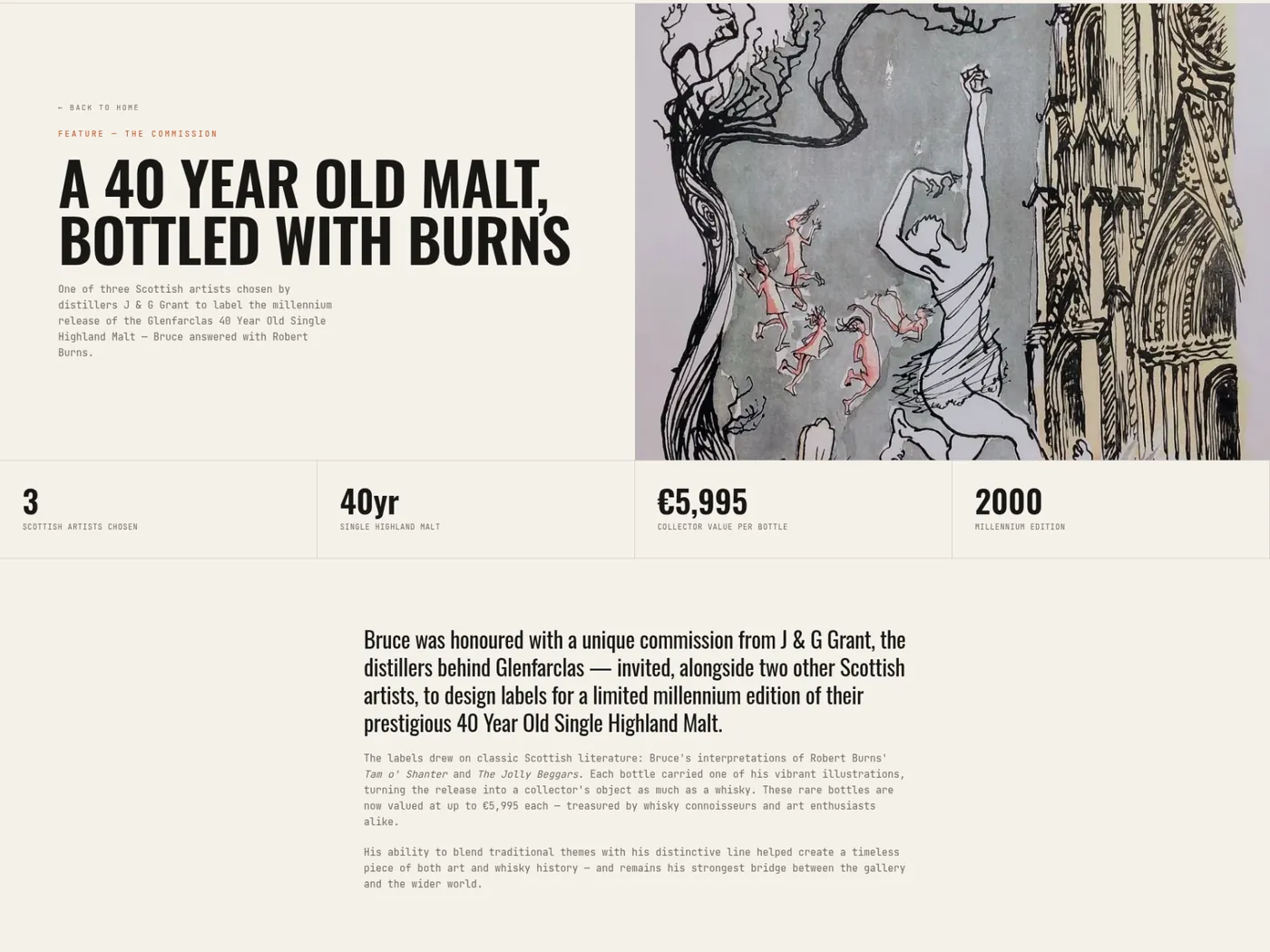
All of it now sits on Cloudflare for free, which, after years of a Squarespace bill that only ever moved one way, feels like its own small victory. It is the same reasoning behind everything I have been moving off rented platforms: own the files, and depend on fewer things you cannot replace.
The result: near-perfect PageSpeed scores on an image-heavy art site
On Google's PageSpeed Insights, the desktop home page now scores 99 for performance, 100 for accessibility, 100 for SEO and 96 for best practices, with a full three-out-of-three pass on agentic browsing. The largest image paints in 0.7 seconds, total blocking time is zero, and layout shift is 0.029. For an art site carrying close to a hundred images, I will take that.
Google PageSpeed Insights, desktop · FCP 0.7s · LCP 0.7s · TBT 0ms · CLS 0.029 · SI 0.8s
What rebuilding my father's website taught me about AI
What stays with me is how closely the result followed the quality of what I put in. A complete extraction and clear, specific feedback meant nothing of his was lost, and my time went on judgement rather than data entry. The tools were fast, but they were carrying out decisions, not making them. And if there is one thing to take away, it is to measure before assuming. The images looked like the problem, and they were part of it, but the real weight was a runtime no one could see, and the most alive part of the build, the part drawn fresh in the browser, was the part that had been keeping his work from being found.
My father's birthday is why I did it now. The work itself was ordinary, lists and files and careful checking. What it leaves behind is not: his paintings, etchings and sculptures, in front of anyone who goes looking for them.
If you have inherited a site, or want to move off Squarespace onto something you own outright, get in touch. Helping people get their work seen and found is exactly what I do. You can also browse my other websites and case studies in the portfolio.
The SEO method behind this rebuild is written up on its own: a free one-page reference and the full Art Website SEO Playbook.