Ethical Tech
Leaving Instagram, Facebook and LinkedIn for Mastodon and Pixelfed
Moving away from Instagram, Facebook and LinkedIn towards ethical social media. Why, what I chose instead, and what happened on my first day on Mastodon.
21 Feb 2026 · 11 min read · By Sophie Kazandjian
A quieter, more human way to show up online.
Maybe you've felt it too. The platforms we've used for years to connect, share our work, and build community have become places that no longer feel aligned with how many of us want to do business, or live. So I've made a decision. I'm in the process of moving away from Instagram, Facebook, and LinkedIn, and towards social media that puts people before profit.
This isn't my first exit. I left Twitter back when Musk took over, fired 80% of the staff, and rebranded it as X. The way the platform and the people who built it were treated made the decision easy. What's taken longer is finding somewhere worth going to instead.
What went wrong with the platforms we know?
The people who run them stopped pretending to care.
Meta (Facebook & Instagram)
Meta's trajectory over the past few years has been troubling. In January 2025, Mark Zuckerberg announced sweeping changes to content moderation across Facebook, Instagram, and Threads, removing independent fact-checkers, rolling back protections against hate speech targeting minorities, and scaling back safety systems. Amnesty International warned that these changes "pose a grave threat to vulnerable communities globally and drastically increase the risk of violence."
Nobody missed the timing. These changes arrived just days before President Trump's inauguration and were widely seen as an effort to win favour with the incoming administration. Months later, Zuckerberg attended a now-infamous White House dinner alongside other tech billionaires, where he was caught on a hot mic asking Trump what investment number he "wanted to go with." The cosy relationship between Big Tech and political power wasn't even trying to hide any more.
Beyond politics, in June 2025 security researchers revealed that Meta had been using Facebook and Instagram apps on Android to covertly track users' web browsing activity, even in Incognito mode, by exploiting a loophole in the device's local network. Google confirmed that the behaviour "blatantly violates" its security and privacy principles. The EU has fined Meta €200 million over its 'pay or consent' subscription model, which the European Commission ruled failed to give users a genuine choice about how their data is used, effectively making privacy a paid privilege. And ongoing court proceedings continue to examine whether Instagram's design features contribute to addictive behaviour in young people.
Profit, political influence, and surveillance come first. People are somewhere much further down the list.
LinkedIn, owned by Microsoft, has its own problems. In 2024, Ireland's Data Protection Commission fined LinkedIn €310 million for violating GDPR through its advertising tracking practices. Then, in early 2025, a lawsuit was filed alleging that LinkedIn had quietly shared Premium users' private messages with third parties to train AI models, without consent. LinkedIn reportedly introduced an opt-out setting only after the fact, and later updated its privacy policy to make the data sharing explicit.
By late 2025, LinkedIn confirmed plans to share user data with Microsoft and its affiliates for AI training, framed under a "legitimate interest" justification that doesn't ask for your permission. You have to actively opt out.
For a platform built on professional trust, that's a betrayal. There's no other word for it.
The bigger picture
None of this is isolated. The tech billionaires who control these platforms have become a class of oligarchs with deep connections to political power, attending White House dinners, pledging hundreds of billions while whispering about which numbers to use, and making content moderation decisions based on political calculations rather than user safety.
The connections between Silicon Valley's elite and figures like Jeffrey Epstein have faced fresh scrutiny, with new documents in 2025 and 2026 revealing more extensive contacts than previously known. While the specifics vary from person to person, the broader picture is one of an extraordinarily powerful, extraordinarily insulated group of people who face very little accountability for the platforms they control.
At some point, continuing to build your business on these platforms starts to feel like you're quietly going along with it. I reached that point.
What I was looking for in ethical social media
My criteria were simple:
No ads, no tracking, no data selling. If the business model depends on surveilling users, it's not ethical.
Open source and transparent. I want to see how the platform works and know that no single billionaire can change the rules overnight.
Community-owned or nonprofit. People before profit, structurally, not just in a mission statement.
Decentralised. No single point of corporate control. If one server goes bad, you can move without losing everything.
No manipulative algorithms. Chronological feeds. No engagement tricks designed to keep you scrolling at the expense of your wellbeing.
The ethical social platforms I chose
After trying a few options, I've settled on two platforms that I'm actively setting up, with a third on my radar for later. Each serves a different purpose, and both share the ethical foundations I was looking for.
Mastodon: my Twitter/Facebook replacement
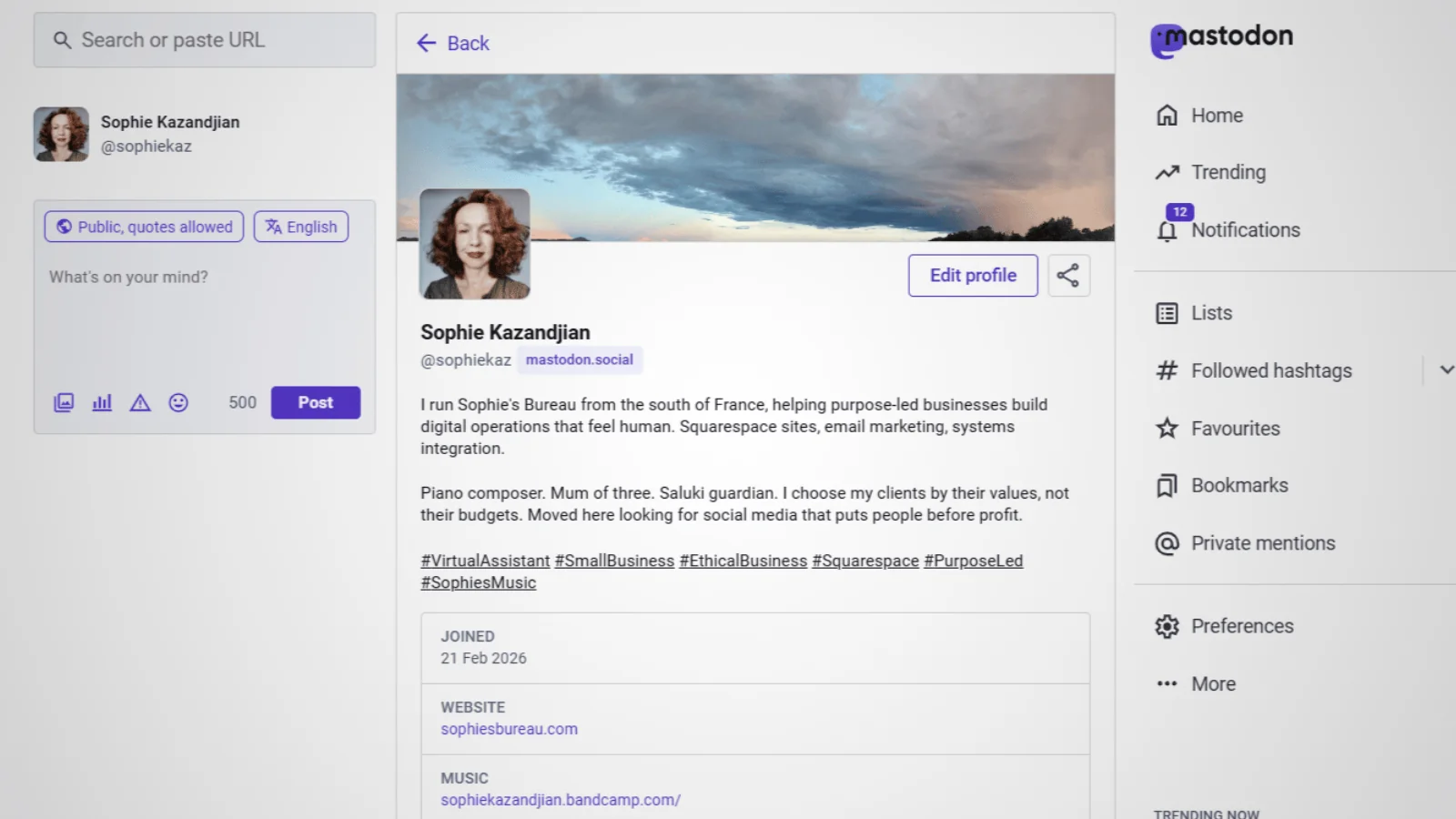
Mastodon is the biggest platform in the Fediverse, with around 1.8 million monthly active users. It works like Twitter: short posts, conversations, sharing. But without a central authority. There are thousands of independent servers ("instances"), each with its own community rules and moderation policies.
What I like:
Chronological feed, so you see posts in the order they were written, not ranked by an algorithm
No ads, no tracking, no data harvesting
Decentralised, with no single company or billionaire controlling the platform
Open source and now operating under a nonprofit structure
Community-driven moderation with tools like content warnings and server-level blocking
Thoughtful, values-driven communities, especially strong among professionals in tech, coaching, academia, and the creative industries
What to know:
Choosing a server can feel confusing at first (but the choice is less consequential than it sounds, and you can always move)
The audience is more niche than mainstream social media
There's no algorithm pushing your content, so growth depends on genuine engagement rather than paid promotion
For sharing insights, articles, and professional commentary, Mastodon feels right. The communities are engaged and the conversations are genuine, closer to what social media felt like before it became a machine for extracting attention.
Pixelfed: my Instagram replacement
Pixelfed is a privacy-focused, open-source photo-sharing platform created by Canadian developer Daniel Supernault. It offers familiar features like photo filters, albums, and Stories, without the surveillance capitalism.
What I like:
No ads, no tracking, no data selling, by design, not as an afterthought
Chronological feed with no algorithm deciding what you see
Community-funded through donations and grants, with no venture capital influence
Supernault is working to register the Pixelfed Foundation as a not-for-profit
Part of the Fediverse (more on this below), so it connects with other ethical platforms
What to know:
The community is smaller than Instagram, so discovery takes more intention
The interface is clean but less polished than what you may be used to
Some features are still evolving
For a visual business like mine, where the quality of design work carries weight, Pixelfed is a natural home. It's a space that values craft over content volume.
Bluesky: one I'm keeping an eye on
Bluesky is a decentralised social network built on the AT Protocol, with over 30 million users. It operates as a benefit corporation, a legal structure that requires the company to consider social and environmental impact alongside profit.
What's appealing:
Growing rapidly, with a much larger user base than Mastodon or Pixelfed, which makes it better for discoverability
Customisable feeds where you choose what algorithms control your experience, or build your own
No use of user content for AI training
Open protocol design means that if the platform ever goes in a bad direction, users can take their data and leave
Why I'm not jumping in yet:
It's a company, not a community-run nonprofit. It's raised $120 million in venture capital and is valued at around $700 million. That's a very different foundation from Mastodon or Pixelfed.
As a benefit corporation, its ethical commitments are legally binding, but it could theoretically change its corporate structure in the future
It uses a different protocol (AT Protocol) from the Fediverse (ActivityPub), so it doesn't interconnect with Mastodon and Pixelfed in the same seamless way
I'm already finding skilled, like-minded professionals on Mastodon who work in my sector, so the "I need Bluesky for reach" argument is getting weaker by the day
Bluesky may become part of my setup eventually. But right now, I'd rather invest my energy in two platforms I fully believe in than spread myself thin across three. I'll revisit it once I've properly settled into Mastodon and Pixelfed.
How they connect: the Fediverse
One of the most exciting things about Pixelfed and Mastodon is that they're both part of the Fediverse, a network of interconnected platforms that all speak the same language (a protocol called ActivityPub).
This means a Pixelfed user can follow and interact with someone on Mastodon. A Mastodon user can comment on a PeerTube video. Content flows across platforms without any single corporation controlling the pipes.
Think of it like email: you can send a message from Gmail to Outlook without either company owning the other. The Fediverse applies that same principle to social media. If your server ever becomes problematic, you can pack up and move, and your connections travel with you.
On Instagram or Facebook, you are the product. On the Fediverse, you're a person.
Is there an ethical alternative to LinkedIn?
There is no strong ethical alternative to LinkedIn. Everyone building in this area knows it's missing. There have been discussions in the Fediverse community about building one, but no mature project has emerged yet.
For now, my plan is to gradually reduce my reliance on LinkedIn while building presence on platforms that align with my values. Mastodon already has thriving professional communities, and I'm finding skilled people in my sector there faster than I expected.
I'll keep a minimal LinkedIn profile for discoverability, but I won't be investing energy there the way I once did.
The trade-offs
What you gain:
Peace of mind, knowing your data isn't being sold, tracked, or fed to AI models without consent
A calmer conscience, knowing your attention and content aren't enriching a class of tech oligarchs whose connections to political power, criminal networks, and the erosion of democratic safeguards are becoming harder to ignore
Calmer spaces with no engagement-bait algorithms and no manufactured outrage
Genuine connections with people who share your values
Ownership of your content and your audience, not handed to a corporation
Alignment between the platforms you use and the kind of business you run
What you give up:
Reach. These platforms have smaller audiences, for now.
Convenience. The interfaces are good but not as slick as Big Tech's.
Passive discovery. Without algorithms pushing your content, growth requires more intentional engagement.
Some professional networking. Until a LinkedIn alternative emerges, there's a gap.
For me, the trade-off is clear. I'd rather have a smaller, genuine audience on platforms I trust than a larger one built on a foundation of surveillance and manipulation.
Something I wasn't expecting: the engagement is instant. Within the first few hours on Mastodon, I had 200 followers. My very first post received 50 replies, 320 boosts, and 360 favourites, and those numbers were still climbing. On Instagram, posting often felt like shouting into the void. Here, people actually show up, read what you've written, and respond. People welcomed me in French, German, and English. They shared resources, offered help, and one person even listened to both of my piano albums and took the time to say so. The community is welcoming, helpful, and encouraging in a way I haven't experienced on social media in years. That caught me off guard.
Where you'll find me
I'm still getting set up, so bear with me as I build these spaces out. If you'd like to follow along, or if you're considering making the same move, I'd love to connect:
Mastodon, for insights, articles, and professional conversation: https://mastodon.social/@sophiekaz
Pixelfed, for visual work, design, and behind-the-scenes: https://pixelfed.social/sophiekaz
If you're a consultant, coach, or purpose-led business owner thinking about making this shift, I'm happy to chat about it. This is new territory for all of us, and figuring it out together is exactly what these platforms are for.
If you've decided to leave and want a step-by-step walkthrough of exporting your photos and data before you go, I've written a full guide: How to Leave Meta: Get Your Data Off Facebook and Instagram.