Case Studies
A One-Page Website Built in an Afternoon, Hosted for Free
A retiring client didn't want to keep paying for Squarespace on a site he'd update twice a year. I built him a one-page site with Claude Design in an afternoon. It now lives on Cloudflare for free. This is the case for asking what the platform subscription is actually doing for you.
20 May 2026 · 7 min read · By Sophie Kazandjian
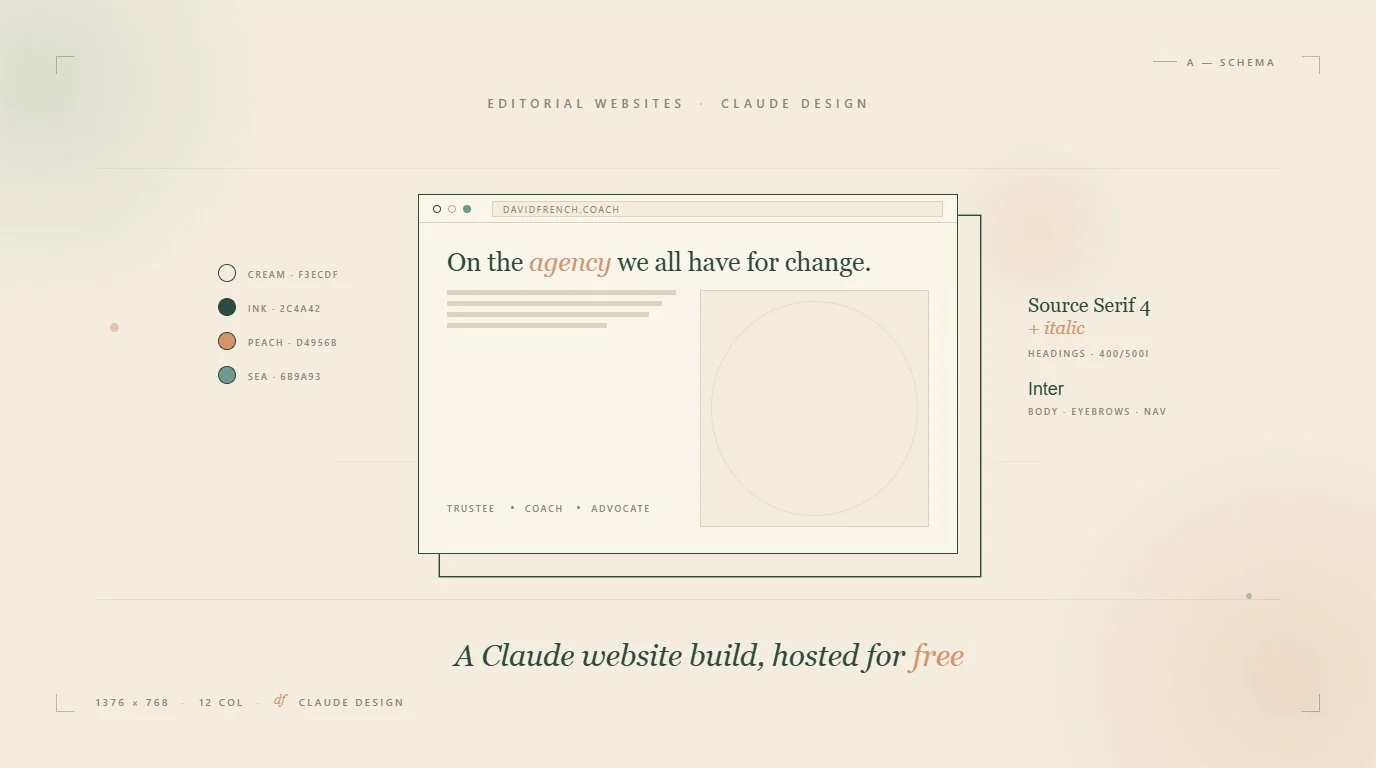
A client of mine retired from coaching this year. He didn't want to keep paying for a Squarespace subscription on a site he'd update twice a year, but he wanted to keep a web presence. Somewhere thoughtful that says who he was, what he did, and how to reach him. I built him a one-page site with Claude Design in an afternoon. It lives on Cloudflare for nothing.
What he wanted
He's had a long career. Senior leadership in business across decades, ongoing governance work in education and the charity sector, public service work running through all of it. He still takes a few coaching clients but the practice has wound down to near-dormant. From the new site he wanted a photograph, the bio he'd written, links to the public-facing roles he still holds, and a way for someone finding him by name to confirm he's the person they were thinking of. What he didn't want was a blog, a newsletter, a bookings widget, or another monthly subscription.
The Squarespace site he already had did a passable version of all this but cost him a monthly bill for an editing interface he'd opened roughly three times in two years. About £170 a year for capability he wasn't using. Retirement made that concrete enough to act on.
Why Squarespace stops fitting a site that rarely moves
Squarespace, Wix, Webflow, and the rest of the hosted platforms are CMSes. What you pay them for is the editing interface and the database that sits behind it. Every month buys the capability to log in, click into a page, type new text, drop in an image, and have those changes go live in seconds. That capability is real, and worth real money if you're using it. For a site that changes weekly, the subscription is a fair trade.
His site doesn't change weekly. He's not going to edit anything for months at a stretch, and when something does need changing he'd rather email me than click through a settings panel. The platform was charging him monthly for an editing UI he wasn't using and hosting he could get elsewhere for free.
A year ago this gap was abstract because the alternative meant either hand-coding a site or learning a static site generator with command-line tools. Now the alternative is asking Claude Design for the page and dropping the result onto Cloudflare Pages. The friction is gone. So is the ongoing cost.
Designing inside a conversation
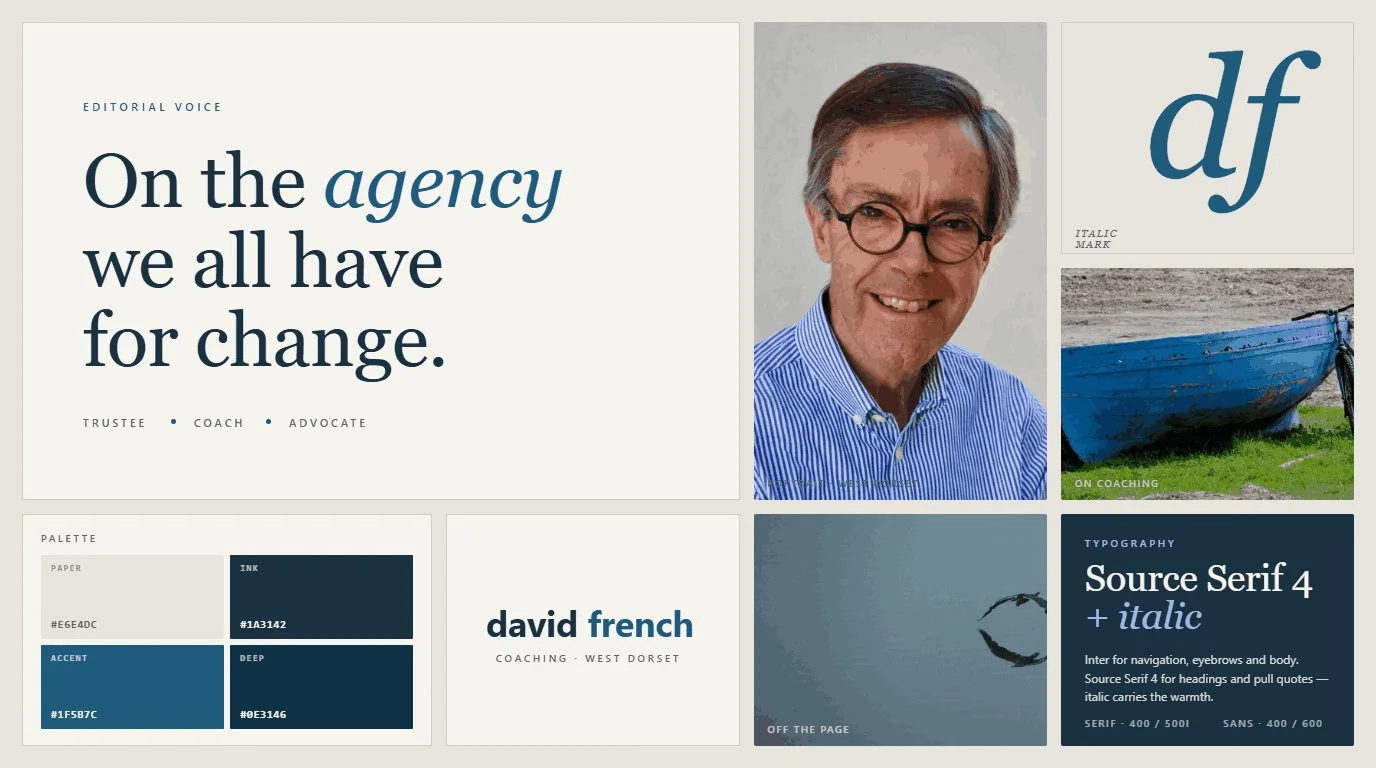
I started in Claude Design with his bio document and a few screenshots of his current site. Claude Design read the bio, picked up the navy-and-warm-grey palette from the screenshots, and proposed a structure for me to react to: hero, pull quote, story, image break, roles section, personal section, contact footer. I worked through each piece.
The hero pairs his headshot with an editorial headline drawn from a line in his bio about the agency we all have for change. A pull quote sits on a paper-coloured band underneath. The story section runs his bio as a single narrative, opening on an anecdote he'd written from earlier in his career, with a drop cap and a sidebar pulled quote. An image break midway uses a photograph he'd taken of a boat with a bicycle tied up next to it, the kind of small detail that says something about the person who notices it, with a Socrates quote overlaid. Four blocks follow for his roles: his executive career, his current commitments, education, public service. Then a personal section with a heron from a coastal spot where the family has long roots, a signoff dated May 2026, and a deep-navy contact footer to close.
Typography: Cormorant Garamond for editorial headings, Manrope for body. Quietly distinguished without slipping into corporate. Spacing is generous. Headings are unhurried. The whole page reads at the pace he sets when he speaks, which is what good editorial design does when it works.
All of this happened in plain English. I described what I wanted. Claude Design produced it. I asked for adjustments. It adjusted. The technical work of writing semantic HTML and tuning responsive layout and choosing line heights sat underneath the conversation, where I didn't need to look at it.
The bits that needed real attention
The site came together quickly. What took longer was the kind of work the AI alone wouldn't have solved.
The heron image was the first. On the initial version, the floating bio card stretched the full width on mobile and hid the heron entirely. I tried CSS hacks to push the bird off to the right with horizontal overflow. The cleaner answer was to crop the image differently. He recropped it to a 2:1 frame with the bird deliberately placed at 75-85% across the horizontal, leaving the left two-thirds as quiet water for the card to sit over. Mobile then lost the bird the other way, because the new wider crop cropped it out at the bottom. The fix was a <picture> swap: desktop uses the new right-biased crop, mobile uses the original centered version where the bird is visible.
That sequence is what working with AI on production design actually looks like. Three rounds, each one driven by a human noticing something specific: that the card was covering the bird, that the cleaner answer was a recrop rather than a CSS hack, that the new crop had reintroduced the original problem from the other side. None of those noticings come from the AI on its own. Technical fixes do. Noticing doesn't.
I added subtle scroll-triggered animations after that. Fade and a small upward shift as elements come into the viewport, with a brief stagger between siblings, and prefers-reduced-motion respected so anyone with reduced motion enabled in their OS sees the page render statically. On a page about a late-career coach reflecting on agency and change, this kind of polish wanted to be present but quiet.
How a one-page site gets to the internet now
When the design was done, what I had was a single HTML file with everything bundled inside: typography, images encoded as data URIs, all the CSS, all the JavaScript. Around nine megabytes, sitting on my desktop.
Getting that file onto the internet under his own domain is now a five-minute job. Open Cloudflare Pages, create a new project, drag the HTML file in. Cloudflare assigns it a free pages.dev URL immediately. To use his own domain, add a CNAME record at his registrar pointing to the Cloudflare project, wait for DNS to propagate, and the site is live.
His site currently lives at davidfrench.pages.dev, with the custom domain still in transit.
There is no monthly bill. No CMS to log in to, no updates to install. When he wants to change something, he sends me the change and I edit the file. If he ever wants to move the site somewhere else, the file is sitting in a folder on my machine, ready to upload to any static host on the planet. He owns it in the sense ownership of a file normally implies, which is a different kind of ownership from what a Squarespace account gives you.
When this works and when it doesn't
This approach works for sites that don't move much: personal pages for people winding down a practice, single-page sites for trades and small services, portfolios that get updated once or twice a year, basic information sites for community groups. The kind of site where the platform's editing tools are theoretical capability paid for monthly and not used.
It doesn't work, or not yet, for sites that need a CMS in earnest: a consultant publishing a weekly newsletter on the same domain, a retailer with a hundred SKUs, a membership site with subscriber-only content. These need the database and the editing UI and the platform integrations, and Squarespace or Webflow or Shopify still earn their keep.
The interesting category is the one in the middle. People who use maybe ten percent of the platform's capability and pay one hundred percent of the bill. That's where this approach is quietly displacing the subscription model. Not by competing on features. By making the subscription's whole reason for existing optional.
I wrote about moving my own site off Squarespace a few weeks ago. That was the more complicated migration: dozens of articles, a portfolio, redirects, an editorial structure. This client's site sits at the opposite end of the spectrum. One page, one file, one upload. Between the two ends, most of the sites I look at for clients fall somewhere on the line, and the line is moving.
If you're winding down a practice, retiring, or simplifying a small business and the platform subscription is starting to feel like dead weight, get in touch. This is the kind of work I help with.