Case Studies
From LetGoIQ to Triage: rebuilding a delegation tool, a year on
A year after LetGoIQ launched, I rebuilt it as Triage. Same decision logic, three structural changes, and a real address of its own. What I changed, what stayed, and why it left the Claude artifact behind.
27 Jun 2025 · 5 min read · By Sophie Kazandjian
A year ago I built a free delegation tool inside a Claude artifact, and used it twice. The decision logic was sound. The tool itself didn't survive a closed tab, and a tool that doesn't remember last week's session solves the wrong half of the problem. This is the rebuild.
What LetGoIQ was, and where it fell short
LetGoIQ was a free web app I published last June. It sorted a sprawling task list into four clean buckets: keep it, pass it on, pause it, or let it go. The categorisation logic came from the way I actually think about delegation in my own work, and it held up over a year of testing on real client lists.
The execution had limits. The app lived inside the Claude chat window, which made the URL someone else's and the experience dependent on whoever happened to be logged in. Closing the tab took the work with it. The urgency input was binary, either urgent or not urgent, which doesn't match the way time pressure actually behaves in most weeks. And there was no way to scribble down a task quickly without first answering five questions about it.
Those limits were what stopped me using it. I'd open the app, do a session, then never come back. Picking up where I left off wasn't a thing the tool supported.
Rebuilding as Triage
The new version lives at triage.sophiesbureau.com. The same decision logic sits underneath, with three structural changes and a handful of conveniences that come with being a real web app instead of an artifact.
Lists persist. Tasks save to the browser the moment they're added. Close the tab, come back next week, the list is exactly where you left it. There's no account and no sign-in, because the data lives only on the device you typed it into.
Urgency has three levels. Urgent this week, soon this month, whenever no rush. Binary urgency forces a small fib about half your tasks. Three levels lets you tell the truth.
Quick-added tasks get a "needs detail" state. Sometimes a task just needs to land on the list before it slips. Hit Enter and Triage takes it in. Because it doesn't know enough yet to categorise it properly, the task sits in a small review queue at the top of the list until you come back to it. Three taps then (skill, impact, urgency) and the rest happens. The longer form is still there if a task deserves more thought.
What stayed the same

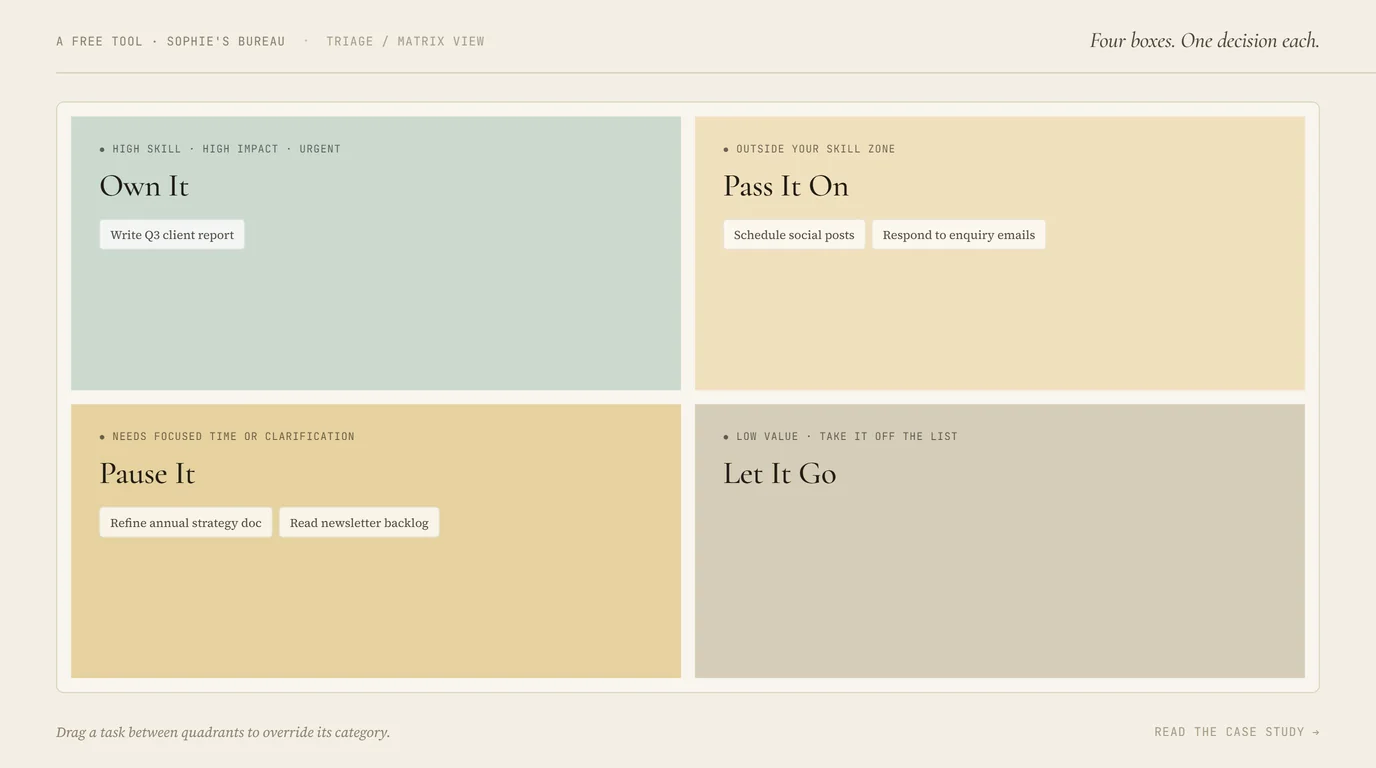
Own It applies to work that's high skill, high impact, and properly yours. Pass It On is for the kind of work better placed somewhere else. Pause It catches important work that doesn't yet have the focus time it needs. And Let It Go is for work that probably shouldn't be on the list at all.
The logic that maps a task's attributes onto one of those four buckets is the same one I tested for a year with LetGoIQ. It worked. It didn't need replacing.
What's new beyond the three structural lifts
A few smaller things came along with the rebuild. There's a matrix view, alongside the list, that plots impact against urgency in a four-square grid. It's useful when the list view starts to feel flat. Multiple lists arrived too, so personal, household, and a couple of client contexts can each have their own space without colliding. And a small delegation brief generator that drafts an email or instruction note for whoever's taking on the Pass It On items. That last one saves the awkward moment of going to hand something off and realising you've never written down what "hand it off" actually means.
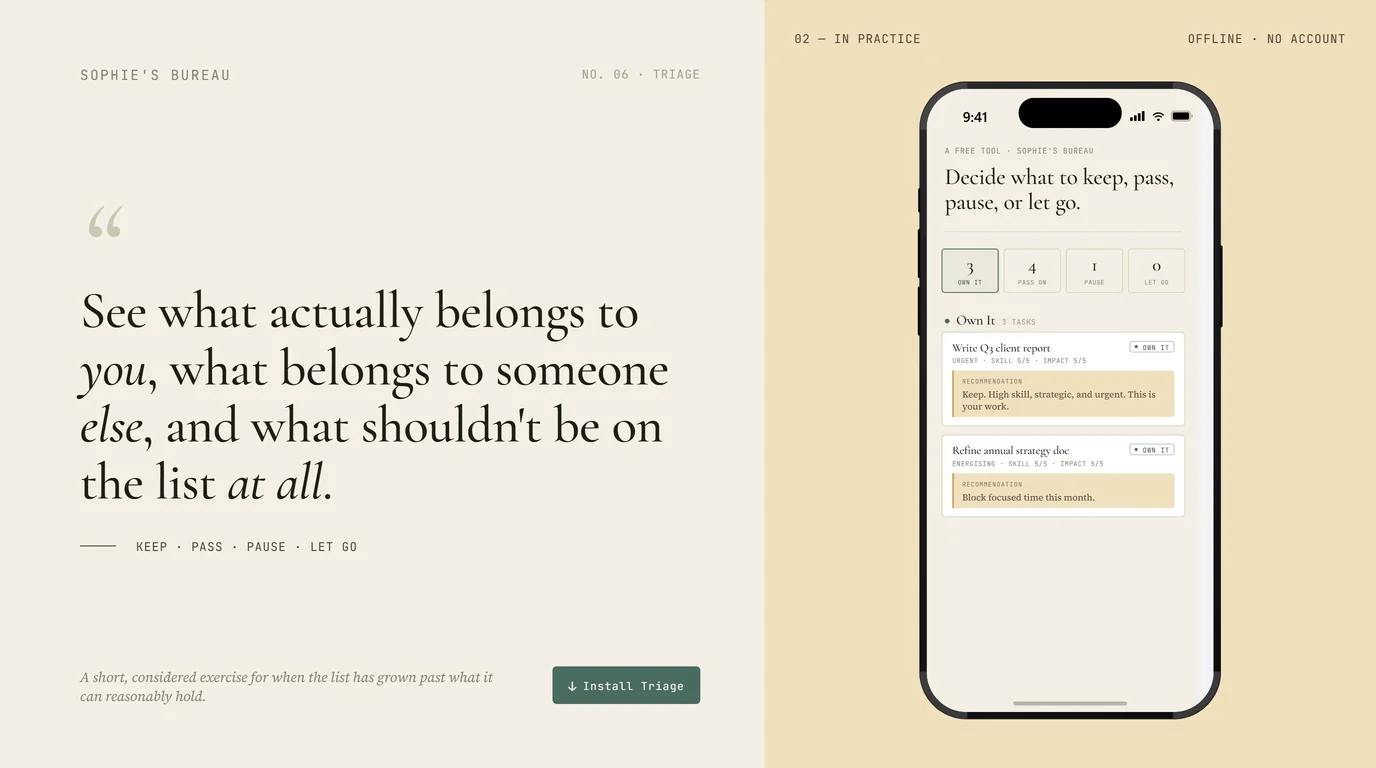
Triage also installs as an app. Add it to your home screen on iPhone or Android, or pin it to a taskbar or dock on a desktop, and it runs in its own window with no browser chrome around it. It works offline once it's there. The install is one tap, not an App Store download.
Why rebuild it outside Claude
Same reason I rebuilt the rest of my website earlier this year. Tools I make should outlive the platforms that hosted the early version. A Claude artifact is fine for prototyping, but the URL isn't yours, the experience depends on someone being logged in to Claude, and the artifact sits among dozens of others that anyone might wander across. Moving the thing to its own subdomain and hosting it on your own infrastructure gets you a product with a real address.
The hosting move also lets me make small editorial choices that an artifact can't. No account form, no email signup, no analytics, no cookies. The bandwidth bill for a tool like this is small enough to be free, and the only data Triage holds is what you choose to type into your own browser.
Try it
Triage is at triage.sophiesbureau.com. It works in any modern browser and installs as an app on every major platform, no account needed. The old LetGoIQ has been retired with this article; if you bookmarked the link, it now goes to Triage instead.
If you've been meaning to make a clearer call about what's actually yours to do and what isn't, Triage is for that.