Essays
The 45 Minutes Before I Open My Laptop
Every morning, before I touch my laptop, I sit with headphones on for 45 minutes. No email. No notifications. Just sound. Why, what the research says, and how.
22 Mar 2026 · 22 min read · By Sophie Kazandjian
How binaural beats and brainwave entrainment became part of my daily work preparation
Every morning, before I touch my laptop, I sit with headphones on for about 45 minutes. No email. No Slack. No Airtable. Just sound.
From the outside, this probably looks like meditation, and in some ways it is. But the practice I’ve built over the past few months is more specific than that. I use binaural beats and brainwave entrainment to prepare my nervous system for the kind of focused, creative, detail-heavy work that digital operations demands.
I should say upfront: I’m not a neuroscientist, and I’m not making clinical claims. What I can share is what I do, what I’ve noticed, and what the published research says about why it might work. If you spend your days switching between client systems, writing, designing, and solving problems, you may find this worth exploring.
What are binaural beats?
The concept is surprisingly simple. When you play one frequency into your left ear and a slightly different frequency into your right ear through headphones, your brain perceives a third tone at the difference between the two. If your left ear receives 200Hz and your right ear receives 210Hz, your brain generates a 10Hz “phantom beat.” That 10Hz falls within the alpha brainwave range, which is associated with relaxed alertness and creative flow.
This auditory phenomenon was first observed by Prussian physicist Heinrich Wilhelm Dove in 1839, using two tuning forks connected by listening tubes to a subject’s ears. Dove’s contribution was more of an initial observation than a full experimental proof, and it wasn’t rigorously explored until later work by Ernst Mach in 1864 and Silvanus P. Thompson in 1877. The real turning point came in 1973, when biophysicist Gerald Oster published his influential paper in Scientific American, tying together decades of scattered research and establishing binaural beats as a legitimate area of neuroscience.
The underlying principle is called brainwave entrainment, sometimes referred to as the frequency-following response. Your brain has a natural tendency to synchronise its electrical activity with rhythmic external stimuli. Different brainwave frequencies correspond to different mental states:
- Delta 0.5 - 4 Hz
-
Delta waves dominate during deep, dreamless sleep. The body undergoes cellular repair, releases growth hormones, and reduces cortisol. Used for deep physical relaxation and sleep transition.
- Theta 4 - 8 Hz
-
Theta is the threshold between waking and sleep. The 4 Hz frequency produces the strongest time perception shifts and is used in weekend reset sessions. The 7.83 Hz Schumann Resonance sits at the theta-alpha boundary.
- Alpha 8 - 13 Hz
-
Alpha brainwaves bridge grounding and active work. The 10 Hz frequency is the core of the morning preparation routine, supporting creative thinking, writing, and strategic planning.
- Beta 13 - 30 Hz
-
Beta is your active working state. Low beta (13-15 Hz) supports calm focus; high beta (20-25 Hz) drives analytical processing. Used as optional background audio during email, scheduling, and operations work.
- Gamma 30 - 100 Hz
-
Gamma waves are associated with peak cognitive performance, heightened perception, and binding information across brain regions. Used in the work routines for complex reporting and strategy tasks (25-40 Hz).
By listening to audio tuned to a specific frequency difference, you can gently guide your brain towards the corresponding state. Headphones are required for binaural beats because each ear needs to receive its own distinct tone.
What the research says
I care about evidence, so before building this into my routine, I spent time with the published studies. The research is encouraging, though it comes with caveats to bear in mind.
Cognitive performance and working memory
A 2019 meta-analysis by Garcia-Argibay, Santed and Reales, published in Psychological Research, analysed 22 studies covering memory, attention, anxiety and pain perception. The analysis found a medium, statistically significant effect size across all domains. The researchers also found that longer exposure periods and listening before (rather than only during) a task produced stronger results.
More recently, a 2025 study published in Scientific Reports examined how different binaural beat parameters affect sustained attention and brain entrainment in 80 participants. The researchers confirmed that binaural beats do produce measurable brain entrainment, and that gamma frequency beats with specific carrier tones improved general attention performance.
A 2026 quasi-experimental study published in the Mental Health Review Journal found that daily 20-minute sessions of 10Hz alpha binaural beats over four weeks significantly improved both cognitive flexibility and working memory, as measured by the Wisconsin Card Sorting Test and the N-back test.
Research published in Frontiers in Neuroscience in January 2026 used graph theory network analysis to examine how binaural beats affect brain connectivity during working memory tasks. The findings showed that alpha beats at 10Hz, beta beats at 14Hz, and gamma beats at 30Hz each modulated brain network connectivity in ways associated with improved cognitive processing.
Anxiety and stress reduction
A 2025 meta-analysis in Complementary Therapies in Clinical Practice examined randomised controlled trials of binaural beats in surgical settings. Across 14 trials involving over 1,000 participants, binaural beats significantly reduced perioperative anxiety compared to both silent controls and conventional audio. The effect was large and statistically significant.
A 2024 systematic review in Applied Sciences examined 12 eligible studies on binaural beats for anxiety and depression. The authors concluded that the evidence supports binaural beats as a viable complementary approach for alleviating anxiety symptoms, particularly in the short term, though more research is needed on long-term effects.
A 2025 study on college students, published in Digital Health, explored how different binaural beat frequencies affect the autonomic nervous system. The researchers found that theta-frequency (6Hz) and alpha-frequency (10Hz) beats both influenced heart rate variability and blood pressure in ways consistent with reduced physiological stress.
The Schumann Resonance connection
The frequency I start with every morning is 7.83Hz, known as the Schumann Resonance. This is the fundamental electromagnetic frequency of the Earth, generated by lightning activity resonating between the planet’s surface and the ionosphere. It was first predicted by physicist Winfried Otto Schumann in 1952.
What makes this frequency so interesting from a neuroscience perspective is that 7.83Hz sits right at the boundary between theta and alpha brainwaves. A 2025 study in PubMed explored the relationship between Schumann Resonance frequencies and human bioelectrical systems, noting that human brainwave activity appears highly responsive to frequencies in this range, and that the autonomic nervous system may synchronise with these natural electromagnetic rhythms.
A randomised, double-blinded study in the Journal of Clinical Medicine used a device outputting Schumann Resonance frequency and found subjective improvements in sleep quality among participants with insomnia, though the researchers noted that more rigorous large-scale studies are needed.
Where the evidence still has gaps
The research is encouraging, and the body of evidence has grown substantially in the past two years. But there are real limitations worth acknowledging. Sample sizes in many studies are small. Methodologies vary widely, making direct comparisons difficult. Individual responses differ. And some studies, particularly around the Schumann Resonance, are correlational rather than definitively causal.
A 2023 systematic review in PLoS ONE by Ingendoh, Posny and Heine examined whether binaural beats reliably entrain brain oscillatory activity. They found that while entrainment does occur, results are inconsistent across studies, partly because of the wide variation in how experiments are designed, from frequency choice to session duration to background masking.
None of this invalidates the practice. It means we're in the early stages of understanding exactly how and for whom brainwave entrainment works best. Individual differences in responsiveness are real, and one factor that appears to play a role is musical training. Research has found that musicians show stronger neural entrainment to binaural beats than non-musicians, likely because years of auditory training make the brain more responsive to fine frequency differences. As a pianist and composer, I'm aware that my own experience may be more pronounced than average. My approach is to pay attention to what I notice while staying grounded in what the science actually shows. Your experience may be different, and that's fine. Start, observe, and let the patterns tell you what's working.
My morning sequence
Here’s the routine I’ve settled into after several months of experimentation.
Step 1: 7.83Hz Schumann Resonance (15 minutes)
I start every morning here. This is the grounding phase. The Schumann Resonance frequency sits at the theta-alpha border, and it brings a quiet, centred feeling that's distinctly different from either coffee-fuelled alertness or groggy half-sleep. It also begins to slow the internal clock. Think of it as calibrating your nervous system before asking it to perform. The structure borrows from how musicians warm up: you start slow, build gradually, and only then move into performance mode. Going straight to theta or gamma without this grounding layer is a bit like opening cold with a technically demanding piece - you can do it, but you lose the depth that the preparation makes possible.
After this, I take a 5-minute quiet buffer. Stay still. No phone, no screen.
Step 2: 4Hz Theta (10 minutes)
This is the step that changed the shape of my mornings. Even a short theta session resets your sense of temporal pressure. You won't go as deep as a 40-minute weekend session, but 10 minutes is enough to begin the shift, especially coming off the Schumann grounding. On mornings when I have a little more room, I extend this to 15 minutes. Stay lying down. Keep a notebook nearby. Theta tends to surface the kind of loose, lateral thinking that gets crowded out by a busy inbox: a solution to something you've been stuck on, a connection between two ideas, or simply a clear sense of what needs your attention first.
After this, another 5-minute buffer. Tea if you want it. Let the transition happen gently.
Step 3: 10Hz Alpha waves (10 minutes)
Sitting up now. This bridges the expanded, slow-time state into creative readiness. Alpha brainwaves are associated with creative flow, learning readiness, and the kind of relaxed-but-alert state that suits thoughtful client work, writing, and strategic thinking. You'll arrive at your laptop feeling both focused and unhurried, which is a combination that's difficult to achieve with caffeine alone.
Step 4: Work, with optional background frequencies
Once I'm at my desk, I sometimes layer 20Hz beta very quietly in the background (no headphones needed at this point) for tasks like email processing, scheduling, and data work. For more demanding tasks like complex reporting, feedback documents, or anything requiring sustained high-level thinking, I move to 25Hz high beta or 40Hz gamma.
The total pre-work routine is about 45 minutes. That sounds like a lot. In practice, the working hours that follow are measurably more focused and productive, and the days feel more spacious rather than compressed. I get through my task list more efficiently, I produce better quality work, and I arrive at the school run feeling less depleted than I used to.
One side effect I didn't expect is that after the routine, I notice sounds I normally filter out. The hum of the fridge, distant sounds carrying from far away, the quiet electrical life of the house. It fades within an hour, but for those first minutes at my desk, the world sounds more detailed and more layered. It's a good indicator that the practice has done its job.
The time perception connection
One of the less obvious effects I’ve noticed is a shift in how time feels. On days when I skip the routine and go straight to my desk, the morning vanishes. Tasks pile up, everything feels urgent, and I reach lunchtime wondering where the hours went. On days when I do the full sequence, the same number of hours somehow feels more spacious. I’m not imagining this. There’s a neurological basis for it.
Your brain’s perception of time passing is governed by an internal timing mechanism driven primarily by the basal ganglia and its dopaminergic pathways, with contributions from the cerebellum and prefrontal cortex. This system functions a bit like a clock, and its speed is influenced by your arousal state. In high-arousal states, when the nervous system is running hot with stress, urgency, or information overload, the internal clock ticks faster. Time feels scarce and compressed. In lower-arousal states, the clock slows, intervals between “ticks” expand, and subjective time dilates.
This is well established in the neuroscience literature. A 2024 review in the Journal of Cognitive Neuroscience examining basal ganglia contributions to perception confirmed that the striatum acts as a population-level time encoder, and that dopaminergic modulation directly affects how quickly this clock runs. Parkinson’s patients, who have depleted dopamine, consistently show measurable distortions in time perception, providing strong evidence that the speed of our internal clock is biochemically and neurologically regulated, not fixed.
What this means in practical terms: when you spend your morning in high beta, scanning emails, processing notifications, and running a low-grade threat assessment on your inbox, your internal clock accelerates. The day feels like it’s running away from you before you’ve accomplished anything. When you start the day in theta and alpha states instead, you’re resetting that clock to a slower, more spacious pace before the demands begin.
There’s a parallel here with the ancient Greek distinction between chronos and kairos. Chronos is clock time: linear, relentless, always running out. Kairos is qualitative time: the right moment, the sense of being fully present, the experience of spaciousness within a finite day. Most modern knowledge work runs entirely on chronos. Frequency practice, in my experience, is one way to access more kairos within the same hours.
There’s also a psychological dimension to this. The “holiday paradox” in memory research describes how periods rich in novel experience feel longer in retrospect, while periods of high stimulation but low novelty collapse in memory to almost nothing. A month of the same screens, the same routines, the same indoor environments can feel like it vanished, even if every day was busy. The morning frequency practice introduces a different quality of experience at the start of each day, and I suspect this contributes to why weeks with consistent practice feel more substantial in retrospect than weeks without.
Theta frequencies do the most work here. The 4Hz theta range sits at the threshold between waking and deep meditation, and even a short session can reset your sense of temporal pressure. On weekends, when time scarcity is the real enemy, a deliberate 20 to 30-minute theta session can change your relationship with the rest of the day.
Getting started: practical guidance
If you want to try this, here are a few things I’ve learned along the way.
The non-negotiable rules
Always use headphones or in-ear monitors for binaural beats. The effect depends on each ear receiving a separate frequency. Speakers won’t work.
Start at a low volume, lower than feels necessary. Build up slowly over sessions. Your auditory system is more sensitive to these frequencies than you might expect.
Treat each session like training a muscle. Start with 10 to 15 minutes and build gradually. Jumping straight into hour-long sessions is a mistake.
Never use binaural beats while driving or operating machinery.
Allow a 30 to 60-minute buffer after a session before re-entering demanding situations. The transition back to full alertness takes time.
Stop immediately if you experience any ear discomfort or ringing.
Note how you feel before and after each session. Patterns emerge quickly.
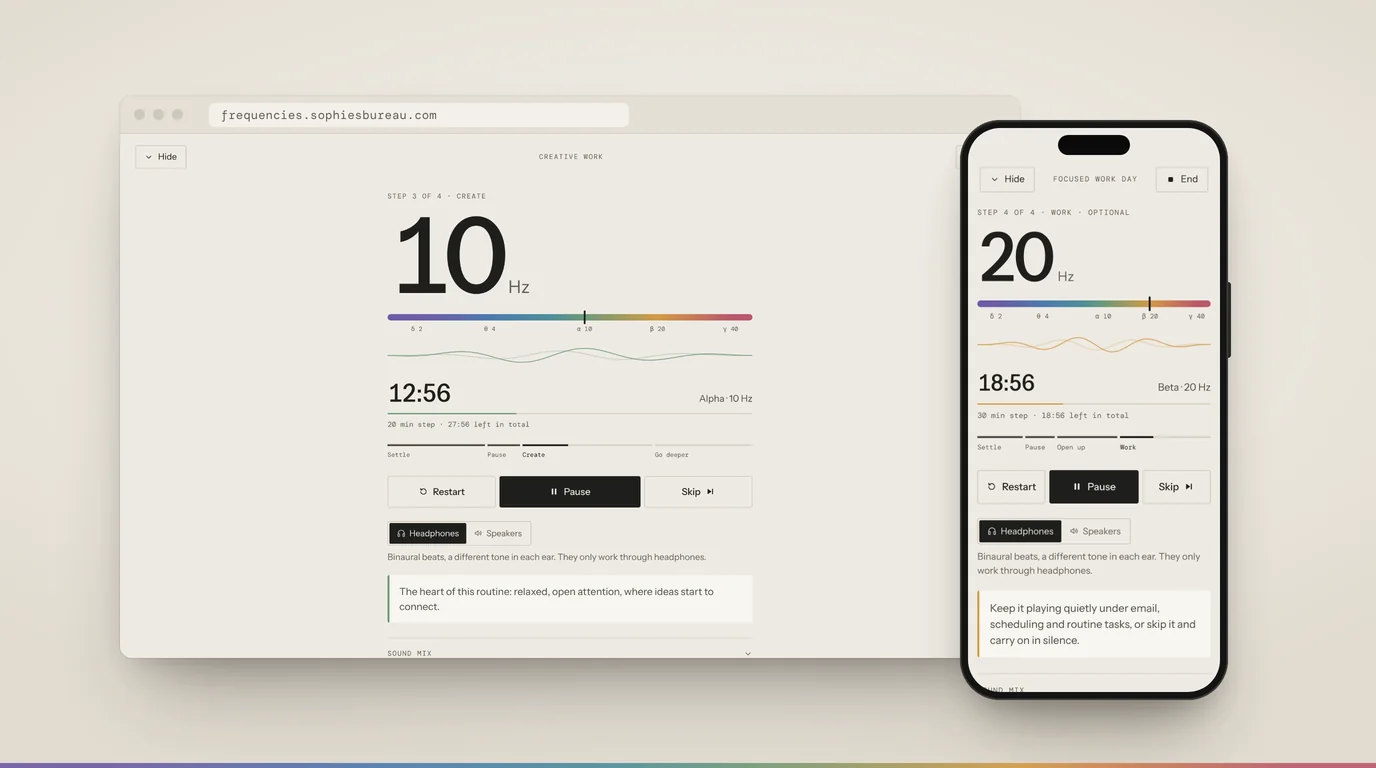
If you want to try any of these frequencies right now, I've built a free app that generates binaural beats and Solfeggio tones in real time. Pick a routine, press Start, and the sound plays through your headphones, or as pulsed tones through your speakers if you'd rather not wear them. No downloads or accounts needed: frequencies.sophiesbureau.com
Isochronic tones: an alternative that works without headphones
Solfeggio isochronic tones work through a completely different mechanism. Rather than presenting two frequencies to separate ears, they use a single pulsing tone that your brain entrains to through rhythmic repetition. The advantage is that they work perfectly well through speakers, making them ideal for ambient background sound while you work.
I use these as background audio in my workspace, particularly 396Hz (associated with releasing tension and fear) and 528Hz (associated with clarity and focus). The research on Solfeggio frequencies is less extensive than for binaural beats, so I hold these more lightly, but I find them a pleasant and grounding ambient layer.
Where to find quality audio
The quality of your source material makes a difference. Poorly produced binaural beats with inaccurate frequency calibration or heavy layering of music can undermine the effect entirely. Here’s what I’d recommend.
Dedicated packs (my recommendation for serious use)
I use packs from EarMonk, which produces pure 432Hz-based binaural beats with low-frequency carriers in high-quality WAV format. The tracks are clean, accurately calibrated, and available as one-off purchases rather than subscriptions. The packs cover the full brainwave spectrum from delta through gamma, and the Solfeggio isochronic tones are sold separately. If you want richly produced ambient compositions to listen to passively, EarMonk is the best source I've found. My own Find Your Frequency app takes a different approach: pure tone generation with guided routines, timers, and step-by-step methodology rather than pre-produced tracks.
Apps for exploring and experimenting
If you want to try binaural beats before committing to dedicated packs, several apps offer a solid starting point:
Binauro (browser-based, also available on Android): A polished free generator covering binaural beats, isochronic tones, bilateral beats, and ambient soundscapes with a spatial audio mixer. A good option if you want full manual control over your frequencies and layered sound design. No login or tracking required.
Binaural (iOS/Mac): A clean, minimalist binaural beat generator. Featured by Apple in 120 countries. Set the frequency, hit play, done. Includes rain sound mixing and Apple Health integration. Free with premium option.
Brain Waves (Android): Lets you set precise frequencies for each ear and save presets. Ten starter combinations covering focus, relaxation and sleep.
Atmosphere (Android/iOS): Combines binaural beats with ambient soundscapes and white/pink/brown noise. A good entry point if you want a more layered, less clinical experience.
myNoise (Android/iOS): A wide-ranging noise machine app that includes binaural beats alongside white noise, nature sounds and other ambient options. Highly customisable.
Free resources
My own Find Your Frequency app generates pure binaural beats and Solfeggio isochronic tones directly in your browser, with twelve guided routines, a builder for your own and a private log of your sessions. It covers the full spectrum from delta through gamma, plus all nine Solfeggio tones. Free, no account required, and installable on your phone for offline use: frequencies.sophiesbureau.com
YouTube and Spotify both have extensive binaural beats content, though quality varies enormously. Search for specific frequencies (e.g., “7.83Hz Schumann Resonance binaural beats”) rather than generic playlists. Be cautious of tracks that layer heavy music over the beats, as this can interfere with the entrainment effect.
EarMonk’s YouTube page also hosts free video content for individual frequencies, a good way to sample before purchasing.
Why this is relevant to knowledge work
I run a digital operations consultancy. My days involve Airtable system design, client communication, Squarespace development, content writing, and strategic thinking. These tasks require different kinds of cognitive engagement: some need deep analytical focus, others need creative flow, and most need sustained attention across multiple context switches.
What I’ve found is that deliberately preparing my nervous system before work, rather than hoping caffeine and willpower will carry me through, has changed both the quality and sustainability of my output. The 45-minute investment pays back across the entire working day.
This connects to a broader principle I’ve been exploring in my Timing, Not Time thinking: that how and when we work is at least as important as how many hours we put in. Frequency practice is one more tool in a toolkit that includes respecting circadian rhythms, planning around energy patterns, and recognising that sustainable productivity starts with biology, not just systems.
I’m sceptical of anything that sounds like wellness fluff, so I’d have dropped this practice quickly if it hadn’t earned its place. The effects were noticeable in the first week and have stayed steady since. Concentration is sharper. Creative work moves more easily. The low-level background anxiety that comes with running a business and holding several client systems in your head at once has quietened, which I notice most on the days I skip the routine and the old static comes back.
If you spend your working days managing complexity, switching contexts, and producing quality output under pressure, this is worth a quiet experiment. And if you’re curious about the other tools and approaches I use to keep things calm and structured, there’s more in the Behind the Work archive.
Find your frequency
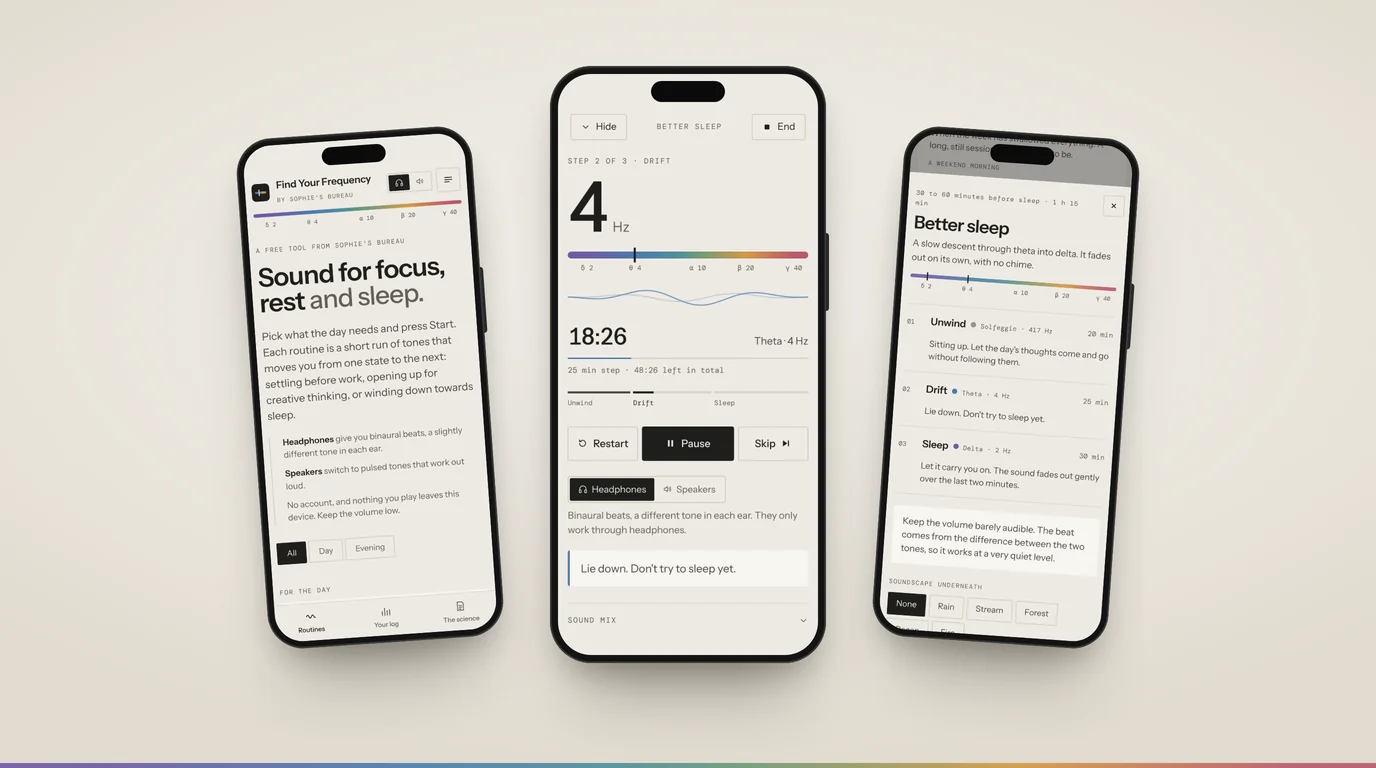
Rather than listing every routine here, I've built an interactive tool that generates the audio for you. Choose what you need right now and it builds a complete session: the right frequencies in the right order, with durations, a short note for each step, and the sound generated live in your browser. The player shows the frequency you're hearing and where it sits on the spectrum, and Better sleep fades out on its own. Headphones give you binaural beats; speakers switch to pulsed tones. There's nothing to download, though you can install it on your phone and use it offline.
FAQs
- Do binaural beats actually work, or is this placebo?
The published research shows genuine, measurable effects. A 2019 meta-analysis of 22 studies found a medium, statistically significant effect on cognition, anxiety, and pain perception. Brain entrainment has been confirmed via EEG in multiple studies. That said, the science is still maturing. Sample sizes tend to be small, methodologies vary, and individual responses differ. My approach: try it, observe carefully, and let your own experience tell you whether it's working. The barrier to entry is a pair of headphones and 15 minutes.
- Do I need expensive headphones for binaural beats?
No. Any decent stereo headphones or earbuds will work, as long as they deliver a separate signal to each ear. Over-ear headphones tend to be more comfortable for longer sessions, but standard wired earbuds are fine. Avoid bone conduction headphones or anything that plays sound through speakers rather than directly into each ear. The binaural effect depends on ear separation, not audio quality.
- Can I listen to binaural beats while working, or only before?
Both, depending on the type of audio. Binaural beats (which require the two-ear frequency difference) need headphones and are best used before work or during dedicated focus sessions. Solfeggio isochronic tones work through a different mechanism, a single pulsing tone, and can be played quietly through speakers as ambient background while you work. I use binaural beats in my morning preparation routine and isochronic tones as a background layer during the working day.
- Are binaural beats safe? Are there any risks?
For most people, yes, it's safe. The main precautions: never listen while driving or operating machinery. Start at a lower volume than feels necessary and build up gradually. Allow a 30 to 60-minute buffer after a session before re-entering demanding situations. Stop immediately if you experience any ear discomfort or ringing. If you have a history of epilepsy or seizures, consult a medical professional before trying brainwave entrainment. This is a personal practice, not medical advice.
- How long before I notice a difference with binaural beats?
I noticed effects within the first week, but I may be more responsive than average due to my background as a pianist and composer (musical training appears to strengthen neural entrainment responses). Most people who stick with a consistent daily practice report noticeable changes within two to four weeks. The key word is consistent. Ten minutes of Schumann every morning for thirty days will do far more than occasional long sessions when you remember.
- Where do I start if I only have 15 minutes?
Fifteen minutes of the 7.83Hz Schumann Resonance, lying down with headphones on, eyes closed, no phone. That's the single most valuable thing in the entire practice. If you do nothing else, do that. Once it feels natural, add 10Hz alpha for 10 to 15 minutes afterwards. Build from there only when you're ready.
References
Published studies referenced in this article, for further reading.